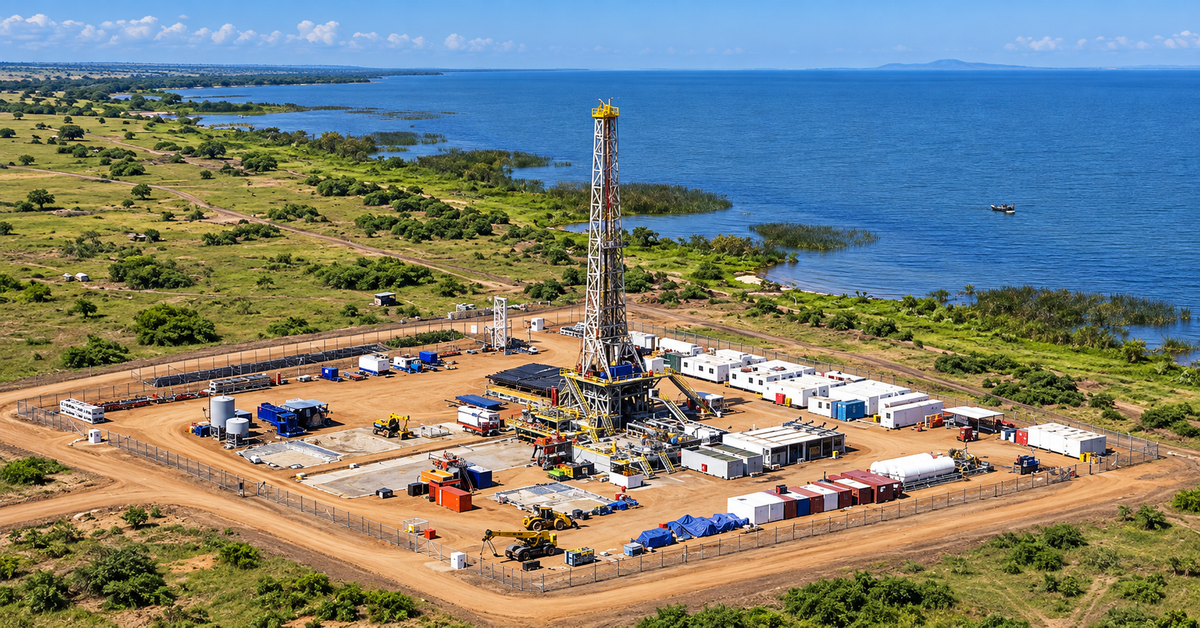
Tony Buckingham was not your conventional oil executive. A former North Sea diver and widely reported to have served in Britain’s Special Boat Service, he had spent much of his career operating in parts of the world where political risk, difficult logistics and uncertain geology were enough to keep larger companies away. Heritage Oil, the company he founded, built much of its early identity around exactly that kind of opportunity, and Uganda fitted the mould rather well.
In 1997, Heritage took an exploration licence in the Semliki Basin in western Uganda. This was frontier exploration in almost every sense. Uganda was landlocked, but that only partly described the problem. Lake Albert sits deep inside the African continent, more than a thousand kilometres from an obvious export point on the Indian Ocean. There was no export pipeline, no established Ugandan oil industry and very little modern subsurface data. Even if Heritage found oil, there was no obvious answer to the question of how it would eventually be sold. Heritage nevertheless began acquiring seismic and in 1998 shot Uganda’s first modern 2D seismic survey.
Early drilling results did not immediately produce the breakthrough the explorers were hoping for. Heritage and Energy Africa drilled the Turaco wells in the south of the basin between 2002 and 2004 and encountered hydrocarbons, but the gas had a high CO2 content. It was evidence that the petroleum system worked, but far from a foundation for an oil industry in such a remote location. Farther north, Australia’s Hardman Resources and Energy Africa were building their own geological picture, and in 2006 they drilled Mputa-1 in the Kaiso-Tonya area. The well encountered oil in shallow sandstone reservoirs and testing demonstrated that it could flow at commercial rates.
Other discoveries followed. Heritage, partnered with Tullow, made the important Kingfisher discovery farther south, while exploration success continued around the northern part of Lake Albert. Within a remarkably short period, the basin had moved from speculative frontier acreage to a proven petroleum province. Three names became central to that first phase of the story: Heritage, Hardman and Tullow. Things were encouraging, certainly, but the remoteness of the discoveries tempered any thoughts of immediate riches.
Tullow Oil became the great consolidator. It had entered Uganda through its acquisition of Energy Africa in 2004, then bought Hardman Resources in a $1.1 billion transaction announced in 2006. Those deals progressively gave Tullow control of much of the acreage on which the early discoveries were being made. Heritage remained an important participant, but by the end of the decade Tullow had become the central commercial force in Uganda’s emerging oil industry.

In 2009, Heritage agreed to sell its Ugandan interests to Eni. Tullow exercised its pre-emption rights, thereby positioning itself to consolidate the principal Lake Albert acreage. The transaction became entangled in a major capital-gains tax dispute with the Ugandan government, an early reminder that remoteness was not the only potential barrier to success. Once the ownership and tax issues were resolved, Tullow brought in partners with much deeper balance sheets. Total and CNOOC each acquired substantial interests in 2012, leaving the three companies with broadly equal positions across the principal Lake Albert licence areas.
It was a logical progression. Heritage, Hardman and Tullow had taken much of the early geological and exploration risk. Total and CNOOC could bring the capital, development capability and long-term financial capacity required to turn the discoveries into a major producing project. Tullow would not ultimately remain for that development phase. Its own balance sheet came under severe pressure following expansion elsewhere, weaker oil prices and operating setbacks, forcing the company into a programme of asset sales and debt reduction. In 2020, it agreed to sell its remaining Uganda interests to Total for $575 million.
Tullow left the country after 16 years, having played a central role in proving and consolidating one of Africa’s more important new onshore oil provinces. Uganda may now be approaching another transition. TotalEnergies, as it is now known, and CNOOC are completing the developments made possible by those earlier explorers, but the infrastructure required to commercialise Lake Albert may also have changed the economics of exploring for the next generation of discoveries.
This article is not a full subsurface or commercial assessment of Uganda. It is an initial screen of something that has caught our attention. The more we have looked at it, the more we think Uganda deserves to be on the radar of a wider range of E&P companies than appears to be the case today. Any company seriously considering entry would need to undertake much deeper work on the acreage, seismic, fiscal regime, licence obligations, development costs and transportation arrangements, but we feel there is enough here to warrant that work.
Uganda beyond the oil fields
Some country context is useful because many international oil investors will have only a limited picture of Uganda beyond the Lake Albert projects. Uganda has a population of around 50 million and sits at the heart of East Africa, bordered by Kenya, Tanzania, Rwanda, South Sudan and the Democratic Republic of Congo. Kampala is a fast-growing regional commercial centre, while the economy has been expanding at roughly 6% in recent years. Construction, services, industry, telecommunications and technology have all developed alongside the more traditional agricultural economy, and investment associated with the petroleum projects is already contributing to further infrastructure development.
Uganda remains a developing country with the challenges that implies. Infrastructure is uneven, incomes remain low by global standards, the state plays an important role in the economy and investors need to understand the political and regulatory environment. None of that makes it unusual among emerging oil provinces. For an upstream company, the more relevant point is that Uganda today is a considerably more developed operating environment than the country Heritage entered in the late 1990s.
The petroleum industry has contributed to that change. Roads and industrial facilities have been built, Ugandan personnel have acquired petroleum experience, regulatory institutions have developed and an oilfield-service supply chain has grown around the Lake Albert developments. Geology may decide where to drill, but logistics, people, equipment and infrastructure have a considerable influence on what it costs to do so.
From exploration success to an operating oil province
The petroleum system around Lake Albert is no longer in doubt. More than six billion barrels of oil have been identified in place in the Albertine Graben, with a significant recoverable resource already established. Numerous discoveries have been made and drilling success has been high. For anyone looking at remaining acreage, the important point is less the precise resource number than the fact that exploration is taking place within a demonstrated oil province rather than an untested geological idea.
The first major development sits to the north of Lake Albert. Tilenga is operated by TotalEnergies and combines a series of fields that will feed a central processing facility before the crude moves into the export system. The second, Kingfisher, lies farther south and is operated by CNOOC. TotalEnergies and CNOOC participate alongside each other in both projects, with Uganda retaining a state interest through the Uganda National Oil Company, UNOC.
Together, Tilenga and Kingfisher are designed to produce around 230,000 barrels a day at peak. More important for future explorers, development drilling is already advanced, facilities are being commissioned and hundreds of wells have been drilled. TotalEnergies still has several rigs operating on Tilenga, while Kingfisher is also well through its drilling programme.
The practical environment facing a new entrant has therefore changed markedly. There are drilling rigs in-country, contractors that know how to operate them, crews with experience of Ugandan reservoirs, service companies supporting completion and well operations, and government institutions that have spent years regulating a large development programme. Baker Hughes is working with UNOC on technical capability and resource assessment, while other international and Chinese oilfield contractors have participated in the existing developments. A company drilling an exploration well tomorrow would be entering a very different operating environment from the one confronted by Heritage, Hardman and Tullow two decades ago.
EACOP changes the proposition
The biggest change is the East African Crude Oil Pipeline. EACOP runs from the Lake Albert development area across Uganda and Tanzania to an export terminal near Tanga on the Indian Ocean. At more than 1,400 kilometres, it is an enormous piece of infrastructure and one that has taken years to finance, permit and construct. Uganda’s crude is waxy, so the pipeline also requires heating along its route, adding materially to its technical complexity. Construction is now in its final stages.
The obvious purpose of EACOP is to commercialise Tilenga and Kingfisher. Its wider significance is that once it begins operating, Uganda will possess something it has never previously had: a physical route carrying crude from Lake Albert to the international oil market.
That changes the exploration proposition. A company can make a technically successful discovery and still create very little economic value if the oil is stranded. A modest field cannot finance a new export pipeline stretching more than a thousand kilometres across two countries, and shareholders are unlikely to keep funding exploration if success simply leads to another unresolved infrastructure problem. For much of Uganda’s modern exploration history, that constraint sat behind every discovery.
EACOP changes that starting point. A new discovery would still require wells, production facilities and some means of connecting into the existing system, but it would not have to solve the much larger problem of creating an entirely new export route from the middle of Africa to the coast.
Crucially for future explorers, EACOP has spare capacity and Uganda has incorporated third-party access into the legal framework governing the pipeline. That provides a potential export route for additional production beyond Tilenga and Kingfisher. The precise capacity available to any new development will depend on timing, incumbent production and the commercial terms agreed, but the important point is that a future discovery does not start life without a route to market.
That is a substantial change. The question is no longer simply, “How could oil found here ever reach a market?” It is increasingly, “What would it cost to connect this discovery to an existing export system?”
The acreage opportunity
Infrastructure only matters if there is still somewhere worth exploring. Despite the success around Lake Albert, significant parts of the Albertine Graben remain lightly explored or unlicensed. Uganda also possesses a substantial historical subsurface database built up through successive exploration campaigns, including extensive 2D and 3D seismic, gravity and magnetic surveys, geological studies and well data.
Some of the most interesting acreage lies around existing discoveries and infrastructure rather than in a completely separate frontier province. Kasuruban is an obvious example. The block is held by UNOC in the northern Lake Albert sub-basin, immediately south of the Tilenga area and northeast of Ngassa. UNOC has been reprocessing existing information, acquiring additional seismic and progressing the acreage towards drilling. In 2025 it sought a joint-venture partner with exploration and operating capability. No equity partner has subsequently been announced publicly, although Baker Hughes has entered a technical collaboration with UNOC covering resource assessment and support for its upstream capabilities.
Kasuruban is not the only potential opportunity. Kanywataba, Ngassa and Turaco have returned to government following the expiry or surrender of previous licences, while other blocks offered in earlier rounds were never awarded. Uganda is preparing another petroleum licensing round expected to include acreage within the Albertine Graben as well as frontier areas elsewhere in the country.
The final acreage package and licence terms will matter, but the direction of policy is clear: Uganda wants another phase of exploration.
The interesting question is what kind of companies might participate. The first exploration cycle provides a useful precedent. Heritage and Hardman were specialist explorers, while Tullow was an independent that expanded through exploration and acquisition. They were prepared to take geological and frontier risk before the development proposition was mature enough for much larger companies.
A similar range of participants could potentially emerge again. At the smallest end of the spectrum, a technically strong subsurface group may be able to begin with existing data rather than drilling. Seismic and well information could be reprocessed and reinterpreted, prospects identified and technical ideas developed. Uganda has legal mechanisms for reconnaissance activity, and both UNOC and the government have an obvious interest in bringing new subsurface thinking into underexplored acreage.
The precise commercial structures would need to be clarified with the authorities, but there may be opportunities to work with government or UNOC around data, geophysics, prospect generation and technical collaboration before taking on the financial commitment associated with a conventional exploration programme.
For a small listed E&P, entry might involve acquiring an interest in a block, reprocessing existing data, shooting targeted seismic and building a drillable prospect inventory. A medium-sized independent could potentially move more quickly towards exploration drilling, while a larger mid-cap might view Uganda as an opportunity to establish a meaningful position in a proven petroleum province with a credible route towards commercialisation.
The government also has reasons to encourage a broader operator base. TotalEnergies and CNOOC dominate the current development phase, but more E&P companies would bring different geological ideas, different appetites for risk and additional sources of capital. A company arriving with credible people, a serious technical proposition and an appropriate financial plan may therefore find a receptive audience.
The work still to be done
Uganda should not be presented as a risk-free exploration opportunity. Any potential entrant would need to understand the fiscal regime, production-sharing terms, government participation, local-content requirements, work commitments and the process for acquiring acreage. Uganda’s petroleum history includes difficult tax disputes, and the commercial relationship between investors and the state needs to be understood before serious capital is committed.
EACOP also requires proper commercial diligence. A new entrant would need to establish the capacity available at the relevant time, the applicable tariff, crude-specification requirements and the cost of connecting a new field. Distance from existing infrastructure could make the difference between an attractive discovery and an uneconomic one.
Environmental and social considerations are also significant. Tilenga and EACOP have attracted sustained international criticism around biodiversity, land acquisition and the pipeline route. Existing developers have undertaken extensive mitigation and compensation programmes, but any new participant would need to form its own view of the operating and reputational environment. The same discipline applies to the subsurface: a proven basin does not make every block prospective, and successful historical exploration does not guarantee that the best discoveries remain to be found.
Those are the areas that need to be investigated before moving from an interesting screen to an investment decision.
Why Uganda has caught our attention
For most of the past twenty years, Uganda presented the oil industry with an unusual combination. Exploration had worked remarkably well, but commercialisation remained extraordinarily difficult. The basin contained oil, but monetising it required solving a huge infrastructure problem.
The environment today is materially different. Tilenga and Kingfisher are nearing production, EACOP is close to completion and offers spare capacity and third-party access, an upstream service industry has been established, and acreage is becoming available as Uganda prepares another exploration cycle.
We have not done the work required to say that Kasuruban, Ngassa, Kanywataba or any other individual block represents an attractive investment. That is not the purpose of this article. What our initial screen suggests is that the opportunity is interesting enough to justify taking the next step.
Nearly three decades after Tony Buckingham’s Heritage Oil began shooting seismic in western Uganda, the geology has been proven, the operating environment has matured and the route to market is almost complete. The combination of available acreage, existing subsurface data, in-country drilling capability and access to EACOP means Uganda now presents a very different proposition from the one faced by the original explorers.
For E&P companies prepared to look beyond the obvious basins, that is enough to justify a serious second look.