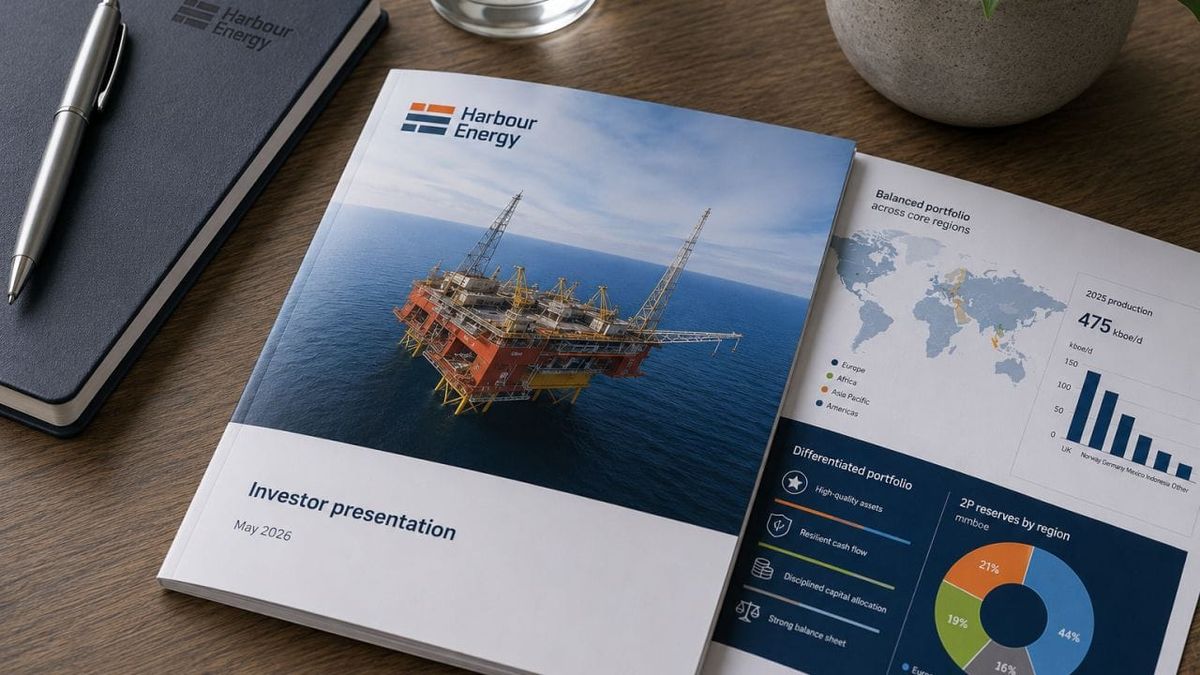
Earlier this summer, I argued that Harbour Energy had changed its assets faster than it had changed its shareholder base. Wintershall Dea transformed what was principally a UK North Sea producer into a much larger international E&P, and LLOG then added a substantial operated position in the Gulf of America.
The company became more diversified, less exposed to a single fiscal regime and strategically stronger. The equity story took longer to catch up. Much of the register still reflected Harbour's past and the transactions that had created the new company, while investors were waiting to see whether greater corporate scale would translate into better outcomes per share.
Some shareholders had chosen Harbour because they wanted a UK North Sea producer. They understood the basin, wanted concentrated exposure to its cash flows and had bought into a relatively simple investment proposition. Wintershall Dea reduced Harbour's dependence on the volatile UK fiscal regime, but it also meant those investors suddenly owned Norway, Germany, Argentina, Mexico, North Africa and other international businesses. LLOG pushed the portfolio further towards the Gulf of America.
At the same time, some of Harbour's largest shareholders had not chosen the company at all. BASF became the largest shareholder because it sold Wintershall Dea. EIG remained from the Chrysaor era. LetterOne received a substantial economic interest through Wintershall Dea, while the LLOG sellers also received Harbour shares.
That combination helped explain the valuation discount. Harbour had assembled the international business before it had assembled the natural shareholder base for it, while greater scale had yet to demonstrate clearly what it would do for each remaining share.
That is changing. Harbour is beginning to look like a different equity proposition: direct exposure to oil and European gas, meaningful organic drilling opportunities, growing cash returns and, increasingly, upstream commodity torque without the same degree of balance-sheet torque.
The register is changing
EIG had reduced its disclosed holding to just 0.29% by early July. BASF has steadily reduced the much larger position it received through Wintershall Dea. Altor has moved in the opposite direction, deliberately buying a substantial position in Harbour rather than receiving shares as consideration for selling it an asset.
The September BASF transaction moved that process forward again. BASF placed 80 million Harbour shares with institutional investors at 266 pence, while Harbour separately agreed to acquire another 53 million shares at the same price for cancellation. The placing alone represented £213 million of stock being absorbed by institutions, and BASF's voting interest was expected to fall from approximately 24.3% to 16.4%.
The market absorbed another very large block of legacy stock without the shares falling through the placing price in the days that followed. Harbour's purchase also means 53 million shares disappear altogether. If those shares are being acquired below the underlying value of the business, every remaining share represents a larger claim on Harbour's assets, cash flow and future distributions.
Altor is important for a different reason. It deliberately chose to buy Harbour as it exists today. That is quite different from appearing on the register because Harbour bought an asset from you.
The register is therefore beginning to reflect investment decisions rather than simply Harbour's transaction history. BASF remains a substantial holder and LetterOne remains economically important, so the transition is not complete. But the direction is clear: legacy positions are being reduced, new institutions are absorbing stock and at least one significant shareholder has deliberately bought into the enlarged international business.
I suspect the same process is happening at retail level, although nominee accounts make it much harder to observe. Some private investors who wanted concentrated UK North Sea exposure will have found that Harbour no longer fits the reason they originally bought it. Their selling does not require a negative view of Wintershall Dea or LLOG; they simply no longer own the type of company they originally selected.
The investors replacing them are buying a different proposition: international diversification, relatively direct exposure to oil and European gas, dividends and buybacks, Gulf of America drilling catalysts and an investment-grade balance sheet.
Scale is starting to show up per share
Corporate scale only helps shareholders if it eventually produces better economics per share. That is where Harbour's recent financial performance becomes more important.
On 6 August, Harbour increased its 2026 free-cash-flow outlook from approximately $1.4 billion to $1.8 billion, announced a new $250 million share buyback and confirmed an interim dividend of 8.05 cents per voting ordinary share. Management also said stronger cash generation would accelerate debt reduction. Harbour had refinanced its $3 billion revolving credit facility to 2031 on improved commercial terms and by then held investment-grade ratings from all three major agencies.
Harbour closed on 6 August at 244p. By 18 September it was 281p, a gain of 15.5%. Including the 5.94 pence dividend that went ex during the period gives a simple shareholder return of about 18%.
I would not attribute that move primarily to a structural rerating. Oil strengthened materially over the same period, European gas also rose and Harbour increased free-cash-flow guidance. Those are powerful explanations for the share-price performance in their own right.
But commodity sensitivity is not something to strip out of the Harbour case. It is part of the case. BP, Shell, ExxonMobil and Chevron contain refining, chemicals, trading and other businesses that diversify the relationship between upstream commodity prices and group cash generation. Harbour remains overwhelmingly an upstream producer, so stronger oil and European gas can feed much more directly into free cash flow.
That cash can reduce debt, fund dividends and buybacks, and finance new projects. For investors who want more direct oil and gas exposure than an integrated major provides, Harbour offers it through a much larger and more diversified asset base than the company had only a few years ago.
The majors are therefore useful comparators for commodity exposure. European upstream independents are more useful for valuation because their business models, portfolios and financing structures are closer to Harbour's.
LLOG adds another dimension. Harbour expects 10–15 Gulf of America wells between 2026 and 2028, including activity at Leon-Castile and Buckskin and infrastructure-led exploration wells. Management estimates that Gulf of America spending over the period can generate a weighted average IRR above 40% at $60 WTI and $4 Henry Hub.
That drilling programme gives Harbour potential upside beyond simply waiting for higher commodity prices. A successful exploration well has limited impact on the valuation of a supermajor. Harbour is large enough to spread drilling risk across a substantial portfolio, but still small enough for successful exploration, a project sanction or new production to move reserves, cash flow and NAV materially.
That combination is attractive. Harbour has more portfolio depth than a small E&P, while individual operating and exploration successes can still make a meaningful difference to the equity.
Investment grade changes the downside
Wintershall Dea also changed the financing structure sitting above those assets. The earlier Harbour relied much more heavily on reserve-based lending (RBL), a financing structure rapidly going out of fashion, and for good reasons. Following Wintershall Dea, Harbour moved towards unsecured corporate credit and achieved investment-grade ratings: Baa2 from Moody's and BBB- from both S&P and Fitch, all with stable outlooks. Its bond maturities extend well into the 2030s.
For an equity investor, investment grade is not primarily valuable because Harbour can borrow more. Its value lies in reducing the probability that creditors eventually determine what happens to the equity.
Debt sits ahead of the ordinary shareholder. Expensive or restrictive financing absorbs cash before anything reaches equity holders. When leverage becomes too high or refinancing becomes difficult, temporary problems in commodity prices, operations or project timing can become permanent equity events through forced asset sales, suspended distributions or new shares issued at depressed prices.
Kosmos and Jadestone show how quickly that mechanism can become important. They are poor short-term share-price comparators for Harbour because highly leveraged equities can respond violently to rising oil prices or balance-sheet relief, but they are useful financing comparisons. Secured borrowing at double-digit coupons, RBL constraints and the potential need for equity all change the risk carried by existing shareholders.
Energean provides a less stressed comparison. It has successfully financed large offshore developments, but significant parts of that financing have been structured around particular assets and subsidiaries. Harbour increasingly finances itself at the corporate level, supported by a diversified international portfolio.
The unsecured structure is important because Harbour does not have to build its financing around individual producing assets. That leaves the portfolio less encumbered and gives management greater freedom to develop, sell, buy or reorganise assets without having financing attached to one part of the business dictate what happens elsewhere.
This is where the character of the equity has changed most. Harbour still gives shareholders considerable exposure to commodity prices, but investment-grade corporate credit means that commodity volatility is less likely to be amplified by financing stress. It increasingly offers upstream commodity torque without the same degree of balance-sheet torque.
There are still obligations to manage. LLOG increased debt, while some of the Wintershall paper Harbour inherited was issued at borrowing costs that would be difficult to reproduce today. Its €1 billion bond due in 2028 carries a coupon of only 1.332%, while another €1 billion due in 2031 costs 1.823%.
The more important question is what Harbour does with the financial capacity it has created. Higher oil and gas prices can accelerate debt reduction, support dividends, fund buybacks or finance organic opportunities such as the LLOG drilling programme. Acquisitions have to compete with those alternatives.
Investment grade is therefore something to protect, not simply something to exploit. The value of having capacity is partly the ability not to use it.
A discount losing its explanation
Harbour has already rerated materially this year, but it remains inexpensive against several established European upstream peers. As at 18 September 2026, consensus data put Harbour on about 6.3 times 2026 earnings, compared with around 7.8 times for Vår Energi, 11 times for Aker BP and a materially higher multiple for Ithaca.
Parts of the sell-side have also started to reassess the equity. On 10 September, Goldman Sachs upgraded Harbour from Neutral to Buy and raised its 12-month target from 250p to 350p. Goldman cited higher expectations for European gas prices and the shareholder-return implications of the $250 million buyback, with its revised commodity assumptions materially increasing its free-cash-flow estimates for 2026 and 2027. Barclays was already positive: on 4 September it reiterated its Buy rating and increased its target from 400 pence to 420 pence.
Broker targets are not the argument, and simple P/E comparisons have obvious limitations across companies with different leverage, tax regimes, production mixes, project portfolios and commodity exposure. The more interesting question is what still justifies Harbour's discount.
The shareholder base was mismatched with the company Harbour had become. That is changing. Large legacy holdings created uncertainty over how much stock the market still had to absorb. EIG has reduced its disclosed position to 0.29%, BASF has reduced materially and new institutional investors are taking the other side.
The company increased debt to transform the portfolio. Stronger free cash flow is now reducing that debt, while the enlarged and more diversified business has achieved investment-grade ratings. Scale had not translated clearly enough into better economics per share; Harbour is paying dividends, buying back stock and cancelling shares.
The portfolio also needed organic opportunities capable of competing with another acquisition for the next dollar of investment. LLOG brought a substantial drilling and exploration programme that can do exactly that.
There are clear ways this thesis could still fail. BASF's remaining position could weigh on the shares for longer than expected. The institutions entering the register may prove transient. Strong commodity prices may fail to translate into sustained debt reduction and better per-share outcomes. Management could use its financial capacity for another large transaction before the existing portfolio has demonstrated its returns. LLOG drilling could disappoint.
The discount could also persist after the register has normalised and leverage has fallen. If that happens, the market may be applying a structural discount for reasons that are not being addressed here.
But those are risks to the argument, not reasons to avoid making it.
A few months ago, the market had good reasons to hesitate. Some of those reasons are now being fixed. The valuation question is therefore changing with them: how much of Harbour's discount should remain if the register continues to normalise, leverage falls, credit ratings remain investment-grade and the enlarged portfolio begins to deliver better outcomes per share?