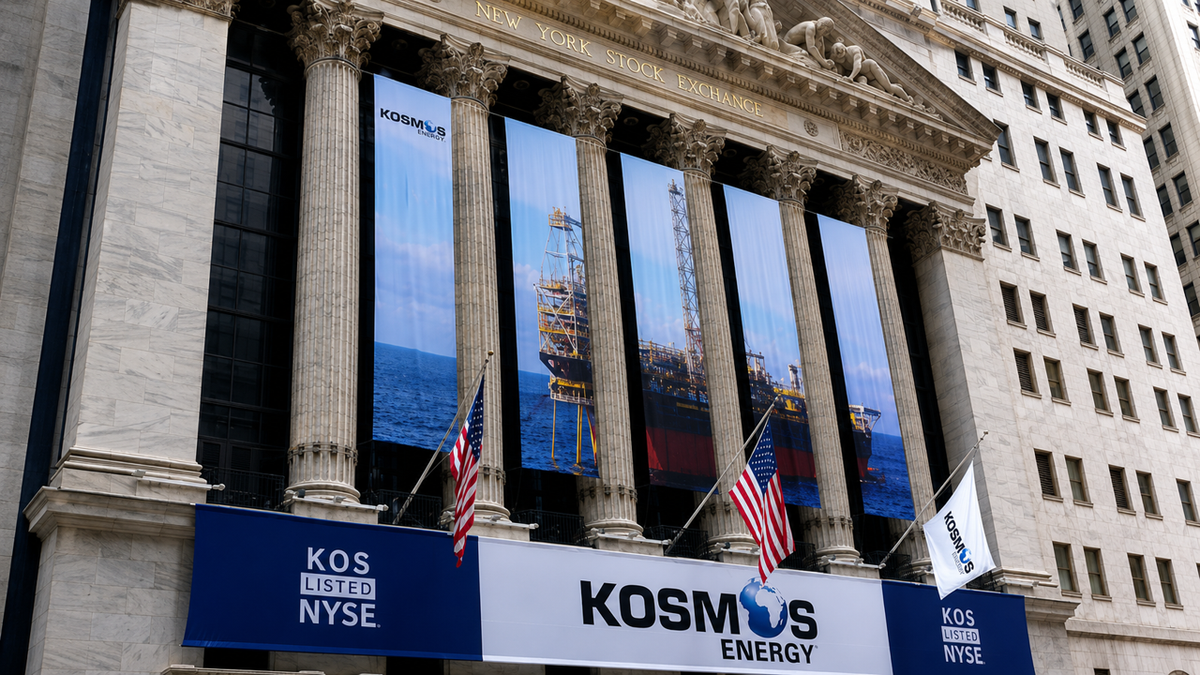
Kosmos Energy came to the New York Stock Exchange in May 2011 at $18 a share. An investor putting $100 into the IPO would have seen those shares become worth less than $14 today. Add the modest dividends paid in 2019 and 2020 and the total value is still only around $15. The same $100 invested in the S&P 500 with dividends reinvested would be worth about $737.
Kosmos discovered Jubilee offshore Ghana in 2007, one of the largest oil discoveries made anywhere in the world that year. It later established another major resource position offshore Mauritania and Senegal, including the Greater Tortue Ahmeyim (GTA) gas field. Today it has interests in producing assets in Ghana, Mauritania and Senegal and the US Gulf of Mexico. At the end of 2025 it reported around 250 million boe of proved reserves and 500 million boe of proved and probable reserves. Second-quarter 2026 production averaged around 71,400 boe/d.
There is no obvious geological failure to explain the shareholder outcome. Kosmos demonstrated that it could find valuable hydrocarbons. The more interesting part of the story is what it did after proving that its exploration model could work.
Jubilee and the IPO
Kosmos was founded in 2003 by a small team that included James Musselman and Brian Maxted. The strategy was exploration-led: find large accumulations through the drill bit rather than build the company by acquiring producing oil and gas assets. Private-equity backing from Warburg Pincus and Blackstone gave the team the capital to pursue large frontier opportunities.
The breakthrough came in Ghana in 2007. Kosmos was operator of the West Cape Three Points Block and drilled the Mahogany-1 exploration well that discovered what became the Jubilee field. This was Kosmos's discovery, not an interest acquired after somebody else had found the oil.
A subsequent well on the adjacent Tullow-operated Deepwater Tano Block confirmed that the accumulation extended across the licence boundary. The discoveries were developed together as Jubilee, with Tullow becoming unit operator. First oil followed on 28 November 2010, only around three and a half years after Mahogany-1.
Musselman retired as chairman and chief executive at the end of 2010. Maxted, another founder and an explorationist by background, became chief executive in January 2011 and took Kosmos public that May. The company's first annual report as a listed business described it as a pathfinding exploration and production company and talked about building a pre-eminent upstream exploration franchise.
The IPO investor was therefore buying a company with a remarkable proof of concept. Kosmos had found Jubilee itself, helped move it rapidly into production and now had the cash flow and public-market capital to try to repeat the exercise elsewhere.
The shares did not reward that investor for long. Kosmos never established itself above the $18 IPO price and by the end of 2014 was trading at around $10.
Andy Inglis became chairman and chief executive in March 2014. Maxted remained Chief Exploration Officer, leaving the company's most important exploration figure responsible for finding new resources while Inglis assumed overall corporate leadership.
Inglis had spent around 30 years at BP, eventually becoming chief executive of its global exploration and production business and an executive director. He left at the end of 2010 during the restructuring that followed the Macondo disaster, subsequently joining Petrofac before moving to Kosmos.
His arrival did not initially change what the company was trying to do. Maxted remained responsible for exploration and some of its most important discoveries were still ahead. Kosmos had shown that it could find hydrocarbons. It had not shown that it could consistently convert that capability into attractive per-share returns.
Tortue and a model that might work
Kosmos's Tortue-1 well in 2015 opened a major new gas province offshore Mauritania and Senegal. Subsequent appraisal expanded the estimated resource and the discovery became large enough to underpin a world-scale LNG development.
Kosmos had operated with very high working interests during exploration. That maximised its exposure when the drill bit succeeded but created a different problem once the discovery moved towards development. A company of Kosmos's size could not fund a project of that scale in the same way as a supermajor without materially changing its financial risk.
In December 2016 it agreed a major transaction with BP. BP took a large working interest and assumed the development role, while Kosmos retained meaningful exposure and continued to lead exploration.
Under the terms announced at the time, Kosmos received $162 million of upfront cash, while BP agreed to carry $221 million of exploration and appraisal spending and up to $533 million of development expenditure. Kosmos exchanged part of its working interest for cash and, more importantly, for BP to shoulder a large part of the capital still to come.
For Inglis, BP was also an organisation he knew extremely well after three decades there. His history with BP may have been relevant, but the transaction stands on its own. Kosmos had discovered and de-risked an enormous resource, retained upside and moved much of the capital-intensive development obligation to a company with the balance sheet, LNG capability and project organisation to carry it.
Kosmos shares rose on the day the BP transaction was announced as investors priced in the news and finished 2016 at around $8, still less than half the IPO price.
The poor share-price performance did not prove that the basic strategy was wrong. Jubilee had been followed by another major exploration success, and the BP transaction showed how a relatively small explorer could retain meaningful upside without trying to finance a giant development itself. Kosmos had a problem translating asset creation into per-share value. One response was to improve that translation.
Instead, the company began changing the strategy itself.
From finding assets to buying them
In 2017 Kosmos expanded into Equatorial Guinea through a joint transaction with Trident Energy to acquire Hess's interests in the producing Ceiba Field and Okume Complex alongside exploration acreage. Kosmos ultimately reported net cash consideration of around $231 million at closing. The structure still retained something of the old model: Kosmos would concentrate mainly on exploration and subsurface work while Trident focused on production operations and optimisation.
KOS finished 2017 at $7.62.
Undeterred, the following year Kosmos went much further. In August 2018 it agreed to acquire Deep Gulf Energy for $1.225 billion, comprising $925 million of cash and $300 million of shares. The cash component was funded through existing credit facilities. Deep Gulf brought an established US Gulf of Mexico business, producing assets and infrastructure-led exploration opportunities. Management expected the acquisition to generate significant free cash flow and support the introduction of a dividend.
This was a fundamentally different capital-allocation proposition from the one on which Kosmos had been built. The founder-era company concentrated capital in areas where it believed it possessed an exploration advantage, created assets through the drill bit and could then reduce its working interest when the resulting development became too large for the balance sheet.
Deep Gulf reversed much of that sequence. Kosmos was using substantial balance-sheet capacity to buy production and reserves that somebody else had already discovered, and buying its way into a basin that the founder-era company had deliberately chosen not to enter.
There is nothing inherently wrong with buying producing assets. Deep Gulf could have justified the strategic change if the returns generated on the capital committed exceeded the purchase price, financing cost and alternative uses of that capital. Production growth, diversification and free cash flow were benefits, but none established that Kosmos had paid the right price.
KOS was around $9.35 at the end of September 2018 and finished the year at $4.44.
GTA was sanctioned in December. Kosmos held 29% of the Tortue unit while BP held 61%, and first gas was expected in the first half of 2022. The BP farm-down had materially reduced Kosmos's exposure, but GTA remained a major multi-year development commitment. The company had therefore used significant balance-sheet capacity to acquire Deep Gulf immediately before entering one of the largest development programmes in its history.
Kosmos then introduced a dividend.
Part of the rationale for acquiring Deep Gulf was that its production would generate free cash flow and support one. But a dividend funded by cash flow from an expensive acquisition is not evidence that the acquisition created value. A company can borrow money to buy cash flow and then distribute some of that cash flow without creating any value at all.
Kosmos had paid $1.225 billion for Deep Gulf, largely using borrowed money, exited 2018 with almost $2 billion of net debt and still had GTA to fund. The economic test was whether the returns on the acquisition exceeded the cost of acquiring and financing the assets and what shareholders might have earned from alternative uses of that balance-sheet capacity.
Retaining the cash would have reduced debt after Kosmos had deliberately increased leverage and before the largest remaining development expenditure on GTA. It would also have strengthened the balance sheet against a fall in commodity prices, a project delay or another disruption.
The dividend delivered one of the promises attached to Deep Gulf, but it did not demonstrate that the acquisition had created shareholder value. It also gave up financial resilience just as leverage and future capital commitments had increased.
KOS finished 2019 at $6.33.
The balance sheet gets tested
Covid and the oil-price collapse arrived the following year and the dividend disappeared. Kosmos shares fell below $1 during the crisis and finished 2020 at $2.68.
Management could not reasonably have been expected to predict a pandemic or the extraordinary collapse in oil demand. It had, however, chosen the financial structure through which shareholders experienced the shock. Kosmos entered 2020 after borrowing heavily to buy production while simultaneously carrying a major LNG development.
The petroleum assets had not disappeared. Jubilee was still producing, Tortue remained a large gas resource and Deep Gulf still contained producing assets. What changed violently was the value left for equity holders after the obligations ahead of them were taken into account.
In 2021 Kosmos deployed capital again, this time into assets it — and by this point we — know well. It agreed a $550 million purchase price with Occidental for additional interests in Jubilee and TEN. After closing adjustments, around $460 million was due at completion. Before partner pre-emption, the transaction increased its interests to 42.1% in Jubilee and 28.1% in TEN. Management expected the additional production to generate near-term cash flow, accelerate deleveraging and help fund the remaining GTA expenditure.
Kosmos knew the assets intimately. The acquired interests were already producing roughly 17,000 b/d net and included an estimated 104 mmboe of 2P reserves. The shareholder test was still whether the expected cash flows justified the capital committed at a time when the balance sheet was already carrying substantial debt and GTA still required funding.
The strategic reversal was striking. Kosmos had built its reputation by discovering Jubilee. Fourteen years later it was spending hundreds of millions of dollars to buy more of it.
KOS finished 2021 at $3.93. Net debt was around $2.5 billion.
There is no need to argue that the Equatorial Guinea assets were poor, that Deep Gulf contained bad reservoirs or that the additional Ghana interests lacked an industrial rationale. Taken together, however, the decisions had transformed Kosmos. A company that had demonstrated with Tortue that it could discover a material resource, bring in a much larger partner and transfer much of the development burden had spent the following years buying production, entering the Gulf of Mexico, increasing its ownership of Ghana and carrying several substantial capital commitments at once.
The replacement strategy required much more capital and placed considerably more risk on the corporate balance sheet. It did not improve the per-share outcome.
GTA takes longer
GTA was supposed to produce first gas in the first half of 2022. It did not.
Kosmos shares recovered during 2022 as oil prices rose, finishing the year at around $6.54, and continued higher during 2023 to around $7.32. In a highly leveraged equity, higher commodity prices and reduced concerns about solvency can produce a disproportionate recovery in the residual value of the shares. Even after that rebound, KOS remained less than half the $18 IPO price and GTA was still absorbing capital.
First gas from the subsea wells eventually arrived on 31 December 2024. First LNG followed in February 2025 and the first cargo was lifted in April, when Kosmos began recognising revenue and cash flow from the project.
Time is a very expensive commodity for a highly leveraged company. Every additional year before cash generation postpones debt reduction, keeps capital tied up for longer and leaves less capacity to absorb problems elsewhere in the portfolio.
KOS finished 2024 at around $3.72.
In December 2024 Kosmos confirmed that it was in very preliminary discussions about a possible offer for Tullow. It withdrew before making a firm bid, but the discussions are revealing. The company had already broadened itself through acquisitions, increased its ownership of Ghana and was still waiting for GTA to become cash generative, yet management was considering another material expansion.
The shares fell when the possible Tullow transaction emerged and rose when Kosmos walked away. Investors priced the prospect of this acquisition negatively and the decision not to proceed positively.
By the end of 2025 GTA was finally producing, but Kosmos had approximately $3 billion of net debt and only $342 million of liquidity. KOS ended the year at around $0.91.
The company had become much larger and broader than the exploration franchise that listed in 2011. It owned more production, more reserves and more developed infrastructure. Yet the residual value attributed to the equity had collapsed.
The Tullow comparison
Tullow and Kosmos are easy companies to put beside each other. Both built their reputations around exploration in Africa, both were involved in Jubilee and both subsequently carried large development programmes and substantial debt.
My Tullow analysis focused particularly on TEN. Tullow entered that development with a 47.175% interest and pursued a farm-down while retaining operatorship. As industry conditions deteriorated, it received offers that it regarded as uncompetitive and decided that selling down was no longer in shareholders' best interests. Tullow therefore retained the full interest through development and entered the 2014 oil-price collapse with a heavily indebted balance sheet.
TEN does not need to have been a bad oil field for that decision to have been financially damaging. A project can contain perfectly good hydrocarbons and still represent too much capital for the company funding it.
Tortue shows that Kosmos handled that problem well in one specific transaction. It found the resource at high equity, brought in BP and transferred much of the development obligation rather than attempting to fund the entire project itself.
Tiberius in the Gulf of Mexico may provide another example. Kosmos and Occidental sanctioned the project in March 2026 with Kosmos holding 50%. By July, Navitas had entered and Kosmos had reduced its interest to 33.34%. The transaction included upfront cash, future milestone payments and a development carry expected to cover Kosmos's expenditure through 2026 and into mid-2027.
Kosmos sanctioned before completing the farm-down, so some sequencing risk remained. But the farm-down happened. Tiberius resembles the Tortue approach: retain meaningful participation without insisting that the corporate balance sheet carries all of the capital. That discipline was not applied consistently elsewhere in the portfolio.
What the shareholder received
The disastrous IPO shareholder return is easy to dismiss with one explanation: perhaps $18 was simply the wrong price?
A $100 investment at the 2011 IPO is worth about $15 today, including dividends. Put the same $100 into Kosmos at the beginning of 2016, after the shares had already fallen substantially, and it is worth about $45.
An investor arriving at the beginning of 2021, after Deep Gulf had been acquired and the company had survived the Covid collapse, has about $94 today. The same $100 invested in the S&P 500 with dividends reinvested would be worth roughly $222.
Even somebody buying at the beginning of 2025, with GTA finally approaching cash generation and the shares already heavily depressed, has only about $67 left.
These investors entered at very different valuations, at different points in the commodity cycle and under different versions of the strategy. Every annual investor vintage from the IPO through the beginning of 2025 is underwater. The problem cannot simply be dismissed as an over-priced IPO in 2011.
The shareholder who bought at the beginning of 2023 is particularly revealing. Jubilee had been producing for more than a decade. Deep Gulf had been acquired, Kosmos had increased its Ghana position and GTA was well into construction. This investor was not paying an IPO premium for an untested exploration story. Their $100 is worth roughly $38.
The 2026 investor is different. Kosmos entered the year as a distressed, highly leveraged oil equity trading below $1. On paper, $100 invested at the beginning of the year would now be worth roughly $277. But that calculation benefits from hindsight: it assumes an investor bought at precisely the distressed starting price without knowing that oil prices would strengthen, refinancing concerns would ease or operating performance would improve. The return illustrates how violently the residual equity of a highly leveraged company can respond when conditions improve; it does not retrospectively validate the capital allocation that created that leverage.
The strategy changes again
So here we are. Kosmos entered 2026 urgently needing to repair the balance sheet. In January it issued $350 million of senior secured Nordic bonds due 2031 at an 11.25% coupon, using the proceeds principally to address nearer-term maturities and repay RBL borrowings. In March it raised around $200 million of equity for debt repayment, diluting existing shareholders at $1.90 a share.
In June it completed the sale of its Equatorial Guinea producing assets to Panoro, receiving around $127 million of cash at completion and directing the proceeds towards the RBL. These were assets Kosmos had bought into in 2017 as it began broadening the company.
Tiberius was farmed down rather than carried at 50%, capital expenditure has been constrained, GTA is finally producing and new Jubilee wells are contributing additional volumes. By the end of June, net debt had fallen to around $2.56 billion, more than $400 million below the end of 2025, while liquidity had risen above $500 million. Second-quarter free cash flow was around $89 million.
Kosmos is now selling assets, reducing development exposure, issuing equity and directing cash towards debt reduction. The shares rose from around $0.91 at the end of 2025 to $2.51 by 12 August. Some of that reflects the oil price and some reflects lower debt, better liquidity, GTA cash flow and improving production. With this much financial leverage, relatively modest changes in enterprise value can produce very large percentage changes in the residual equity.
The actions being taken now look very different from much of the preceding decade. An acquired producing business has been sold, development exposure has been reduced through a farm-down and capital is being directed towards debt repayment rather than another acquisition or a dividend. An 11.25% secured bond and an equity issue at $1.90 also show how much financial flexibility had already been lost.
Equatorial Guinea was one of the first steps in broadening the company and has now been sold to reduce debt. Tiberius is being diluted rather than carried at high equity. Cash is being retained for the balance sheet rather than distributed. The resemblance to the Tortue approach is difficult to miss, except that Kosmos is now making these decisions after the balance sheet has already forced the issue.
What should the shareholder want now?
Take the investor who put $100 into Kosmos at the beginning of 2023 and now has about $38. Let us imagine that investor can tell the board what to do.
The chief executive and some long-serving directors now being asked to decide what Kosmos should become were also in place for much of the strategic shift, although other members of the current board joined more recently. That does not automatically make the existing leadership the wrong people to lead the next phase, but shareholders should not simply assume that they are the right ones either. Any serious review should be prepared to question the portfolio, capital structure, leadership, incentives and board composition without attachment to the strategy that produced the present position.
A transformational acquisition is off the table for a start. The abandoned Tullow discussions are enough of a reminder that making Kosmos larger is not itself a strategy for making a Kosmos share more valuable. Continuing the deleveraging programme is credible: GTA is finally producing, development exposure at Tiberius has been reduced and cash flow can now reduce debt rather than finance another major addition to the portfolio. Kosmos could go further and operate explicitly as a harvest-and-deleveraging company, putting discretionary expansion behind balance-sheet repair until leverage is substantially lower.
Asset sales should also be considered on their merits rather than rejected because they reduce the size of the company. Part of GTA could be monetised. Shareholders have finally funded a major LNG development through to production and would be selling exposure just as cash starts arriving, so the price would need to compensate them adequately for giving that up.
Ghana could also be reduced. The question is not whether Jubilee contains attractive hydrocarbons, but what another owner would pay for Kosmos's interest compared with the value shareholders receive from retaining it inside the existing capital structure. The Gulf portfolio could be tested on the same basis, with other companies providing more development capital where the economics justify it.
There is no reason to assume that Ghana, GTA and the Gulf need to remain within the same listed company simply because Kosmos accumulated them over time. Kosmos ended the second quarter with around $2.56 billion of net debt against an equity market value of roughly $1.5 billion. The board should establish what those businesses are worth separately to their natural owners after tax, partner rights, government approvals, transaction costs, stranded overhead and debt repayment.
A sale of Kosmos itself must belong as an option in the same exercise. A larger company with a stronger balance sheet may be able to own exactly the same petroleum assets at a lower cost of capital, in which case those assets could be worth more under somebody else's ownership than public shareholders are prepared to pay for them inside Kosmos. A break-up or sale may prove inferior to operating the company and reducing debt, but the numbers should establish that rather than an institutional attachment to preserving Kosmos in its present form.
Kosmos has already demonstrated that it can find hydrocarbons. Jubilee proved it, and Mauritania and Senegal proved that it could do it again. The original strategy was not obviously bad; its failure was that asset creation did not translate adequately into returns for public shareholders.
Management responded by changing the company. Kosmos bought production, entered the Gulf of Mexico, increased its ownership of Ghana and became a much more capital-intensive full-cycle E&P. Each decision could be explained in terms of production, reserves, diversification or cash flow. The replacement strategy still had to make the shareholder better off.
It did not. The asset base expanded, production became more diversified and the balance sheet grew with it. The shareholders did not get richer.
Kosmos has already demonstrated that it can find commercial hydrocarbons. The question for the board is whether those assets are worth more to shareholders inside Kosmos than they would be under different ownership.Kosmos Energy came to the New York Stock Exchange in May 2011 at $18 a share. An investor putting $100 into the IPO would have seen those shares become worth less than $14 today. Add the modest dividends paid in 2019 and 2020 and the total value is still only around $15. The same $100 invested in the S&P 500 with dividends reinvested would be worth about $737.
Kosmos discovered Jubilee offshore Ghana in 2007, one of the largest oil discoveries made anywhere in the world that year. It later established another major resource position offshore Mauritania and Senegal, including the Greater Tortue Ahmeyim (GTA) gas field. Today it has interests in producing assets in Ghana, Mauritania and Senegal and the US Gulf of Mexico. At the end of 2025 it reported around 250 million boe of proved reserves and 500 million boe of proved and probable reserves. Second-quarter 2026 production averaged around 71,400 boe/d.
There is no obvious geological failure to explain the shareholder outcome. Kosmos demonstrated that it could find valuable hydrocarbons. The issue actually seems to revolve around how a company built around rare, high-impact exploration events should operate once it becomes a sizeable public company, and what happens when management tries to solve that problem by changing the business itself.
Jubilee and the IPO
Kosmos was founded in 2003 by a small team that included James Musselman and Brian Maxted. The strategy was exploration-led: find large accumulations through the drill bit rather than build the company by acquiring producing oil and gas assets. Private-equity backing from Warburg Pincus and Blackstone gave the team the capital to pursue large frontier opportunities.
The breakthrough came in Ghana in 2007. Kosmos was operator of the West Cape Three Points Block and drilled the Mahogany-1 exploration well that discovered what became the Jubilee field. This was Kosmos's discovery, not an interest acquired after somebody else had found the oil.
A subsequent well on the adjacent Tullow-operated Deepwater Tano Block confirmed that the accumulation extended across the licence boundary. The discoveries were developed together as Jubilee, with Tullow becoming unit operator.
Before first oil, Kosmos attempted to monetise its Ghana position through a sale to ExxonMobil. The proposed transaction would have provided an obvious exit route for the private-equity investors that had financed Kosmos through its exploration phase and would also have represented powerful industry validation of the value created at Jubilee.
The transaction ran into sustained opposition in Ghana. Government consent was required, GNPC opposed the proposed transfer and the authorities made clear that the sale would not be approved in its existing form. Exxon ultimately terminated the agreement in August 2010 without giving Kosmos a reason. Given the political and regulatory opposition surrounding the transaction, the termination should not be interpreted as Exxon making a negative judgement on Jubilee itself.
Jubilee achieved first oil on 28 November 2010, only around three and a half years after Mahogany-1. The strategic sale had failed, but the underlying investment had de-risked further. Kosmos now owned an interest in a producing major discovery, possessed a demonstrable exploration track record and still had a portfolio of prospects to pursue.
Musselman retired as chairman and chief executive at the end of 2010. Maxted, another founder and an explorationist by background, became chief executive in January 2011 and took Kosmos public that May. The company's first annual report as a listed business described it as a pathfinding exploration and production company and talked about building a pre-eminent upstream exploration franchise.
The timing of the IPO made considerable sense. Public investors were not being asked to finance an unproven geological idea. Jubilee had demonstrated the capability, first production had arrived and fresh equity could fund the next exploration and appraisal programme. The flotation also established a public valuation for the substantial interests retained by Warburg, Blackstone and management and created a route through which those holdings could eventually become liquid.
The IPO investor was therefore buying a compelling proposition: a team with a track record, a producing proof of concept and the capital to try to repeat its success elsewhere.
The difficulty was less obvious. High-impact exploration creates value through large but infrequent events. A company cannot know when the next Jubilee will be discovered, how large it will be or whether the next several wells will succeed at all. Nor can a mid-cap explorer simply drill enough statistically independent, company-changing prospects every year to turn those uncertain outcomes into a predictable stream of value creation.
A supermajor can carry high-impact exploration inside a much larger production and cash-flow base. A small speculative explorer can exist around a handful of clearly understood drilling catalysts. Kosmos increasingly occupied the awkward space between the two: a sizeable public company whose most distinctive capability created value in events that were inherently impossible to schedule.
The shares did not reward the IPO investor for long. Kosmos never established itself above the $18 offering price and by the end of 2014 was trading at around $10.
Andy Inglis became chairman and chief executive in March 2014. Maxted remained Chief Exploration Officer, leaving the company's most important exploration figure responsible for finding new resources while Inglis assumed overall corporate leadership.
Inglis had spent around 30 years at BP, eventually becoming chief executive of its global exploration and production business and an executive director. He left at the end of 2010 during the restructuring that followed the Macondo disaster, subsequently joining Petrofac before moving to Kosmos.
His arrival did not initially change what the company was trying to do. Maxted remained responsible for exploration and some of its most important discoveries were still ahead.
Tortue and a model that might work
Kosmos's Tortue-1 well in 2015 opened a major new gas province offshore Mauritania and Senegal. Subsequent appraisal expanded the estimated resource and the discovery became large enough to underpin a world-scale LNG development.
Kosmos had operated with very high working interests during exploration. That maximised its exposure when the drill bit succeeded but created a different problem once the discovery moved towards development. A company of Kosmos's size could not fund a project of that scale in the same way as a supermajor without materially changing its financial risk.
In December 2016 it agreed a major transaction with BP. BP took a large working interest and assumed the development role, while Kosmos retained meaningful exposure and continued to lead exploration.
Under the terms announced at the time, Kosmos received $162 million of upfront cash, while BP agreed to carry $221 million of exploration and appraisal spending and up to $533 million of development expenditure. Kosmos exchanged part of its working interest for cash and, more importantly, for BP to shoulder a large part of the capital still to come.
For Inglis, BP was also an organisation he knew extremely well after three decades there. His history with BP may have been relevant, but the transaction stands on its own. Kosmos had taken the risk at the point in the value chain where it had demonstrated a genuine capability, then reduced its exposure when the nature of that risk changed from geology towards capital, LNG execution and large-project delivery.
Kosmos shares rose on the day the BP transaction was announced as investors priced in the news and finished 2016 at around $8, still less than half the IPO price. By then, however, management faced a tricky strategic problem. Jubilee and Tortue suggested that its exploration capability was real, yet the public-market outcome remained poor. The company needed a more dependable valuation and cash-flow base between episodic and hard to time exploration events. Simply continuing to promise the next Jubilee was unlikely to solve that problem.
Nor could management easily describe the situation in those terms. Kosmos had been floated on the proposition that it could build a pre-eminent exploration franchise. A strategic change therefore needed to be presented as an evolution of that model rather than an acknowledgement that high-impact exploration alone was an uncomfortable foundation for a public company of its size.
Predictable free cash flow offering a dependable return, with high-impact exploration providing the upside, was a credible model for the evolved Kosmos. The problem was that Kosmos did not execute what was, in principle, a perfectly sensible strategy particularly well.
From finding assets to buying them
In 2017 Kosmos expanded into Equatorial Guinea through a joint transaction with Trident Energy to acquire Hess's interests in the producing Ceiba Field and Okume Complex alongside exploration acreage. Kosmos ultimately reported net cash consideration of around $231 million at closing. The structure still retained something of the old model: Kosmos would concentrate mainly on exploration and subsurface work while Trident focused on production operations and optimisation.
KOS finished 2017 at $7.62.
The following year Kosmos went much further. In August 2018 it agreed to acquire Deep Gulf Energy for $1.225 billion, comprising $925 million of cash and $300 million of shares. The cash component was funded through existing credit facilities. Deep Gulf brought an established US Gulf of Mexico business, producing assets and infrastructure-led exploration opportunities. Management expected the acquisition to generate significant free cash flow and support the introduction of a dividend.
The industrial rationale was understandable. Kosmos needed more dependable production and cash flow if it was going to remain a sizeable listed company while continuing to pursue high-impact exploration.
The financial question was how much stabilising production it needed, what that production should cost and how much balance-sheet capacity should be consumed to acquire it.
Deep Gulf represented a fundamental change in the way Kosmos deployed capital. The founder-era company had concentrated capital in areas where it believed it possessed an exploration advantage, creating assets through the drill bit and reducing its working interest when resulting developments became too large for the balance sheet.
Deep Gulf reversed much of that sequence. Kosmos was using substantial balance-sheet capacity to buy production and reserves that somebody else had already discovered, while entering a basin the founder-era company had deliberately chosen not to pursue.
There is nothing inherently wrong with buying producing assets or becoming a full-cycle E&P. The burden of proof simply changes. Once Kosmos was buying existing cash flows, exploration skill could no longer by itself justify the capital allocation. Management needed to demonstrate why those assets were worth more in Kosmos's ownership than the price paid to acquire them.
Production growth did not answer that question. Kosmos had bought production. Reserve growth did not answer it either. It had bought reserves. Free cash flow was similarly incomplete: a company can always acquire more cash flow if it is willing to pay enough for it.
Diversification also has limits as a value proposition. A shareholder can diversify independently by owning several companies. For Kosmos to use corporate capital and leverage to assemble that diversification internally, common ownership needed to produce something the shareholder could not obtain cheaply in the market: operating synergies, superior subsurface insight, lower costs, infrastructure advantages, cheaper capital or an acquisition price below intrinsic value. The shareholder test was whether those benefits justified the capital committed.
KOS was around $9.35 at the end of September 2018 and finished the year at $4.44.
GTA was sanctioned in December. Kosmos held 29% of the Tortue unit while BP held 61%, and first gas was expected in the first half of 2022. The BP farm-down had materially reduced Kosmos's exposure, but GTA remained a major multi-year development commitment.
Balance-sheet capacity therefore had considerable value. Every dollar committed to buying Deep Gulf was also a dollar unavailable for GTA, future exploration, debt reduction or protection against an unexpected downturn.
Kosmos then introduced a dividend.
Part of the rationale for acquiring Deep Gulf was that its production would generate free cash flow and support one. But a dividend funded by cash flow from an acquisition does not demonstrate that the acquisition created value. A company can borrow money to buy an income stream and then distribute part of that income stream to shareholders while earning an inadequate return on the capital invested.
Kosmos had paid $1.225 billion for Deep Gulf, largely using borrowed money, exited 2018 with almost $2 billion of net debt and still had GTA to fund. The economic test was whether the returns on the acquisition exceeded the cost of acquiring and financing the assets and what shareholders might have earned from alternative uses of that balance-sheet capacity.
Retaining the cash would have reduced debt after Kosmos had deliberately increased leverage and before the largest remaining development expenditure on GTA. It would also have preserved capacity against lower commodity prices, project delay or another disruption.
The dividend delivered one of the promises attached to Deep Gulf. It did not prove that Deep Gulf had created shareholder value, and it reduced financial resilience just as leverage and future capital commitments had increased.
KOS finished 2019 at $6.33.
The balance sheet gets tested again
Covid and the oil-price collapse arrived the following year and the dividend disappeared. Kosmos shares fell below $1 during the crisis and finished 2020 at $2.68.
Management could not reasonably have been expected to predict a pandemic or the extraordinary collapse in oil demand. The pandemic was not the strategic mistake. It was a stress test of the financial structure management had chosen before the shock arrived.
Kosmos entered 2020 after borrowing heavily to buy production while simultaneously carrying a major LNG development. Jubilee was still producing, Tortue remained a large gas resource and Deep Gulf still contained producing assets. What changed violently was the value left for equity holders after the fixed claims ahead of them were taken into account.
In 2021 Kosmos deployed capital again, this time into assets it — and by this point we — know well. It agreed a $550 million purchase price with Occidental for additional interests in Jubilee and TEN. After closing adjustments, around $460 million was due at completion. Before partner pre-emption, the transaction increased its interests to 42.1% in Jubilee and 28.1% in TEN. Management expected the additional production to generate near-term cash flow, accelerate deleveraging and help fund the remaining GTA expenditure.
Kosmos knew the assets intimately. The acquired interests were already producing roughly 17,000 b/d net and included an estimated 104 mmboe of 2P reserves.
Familiarity reduced information risk. It did not determine whether the purchase price represented good capital allocation. Kosmos was still carrying substantial debt and GTA still required funding.
The strategic reversal was striking. Kosmos had built its reputation by discovering Jubilee. Fourteen years later it was spending hundreds of millions of dollars to buy more of it.
KOS finished 2021 at $3.93 with net debt at around $2.5 billion.
There is no need to argue that Equatorial Guinea was a poor asset, Deep Gulf contained bad reservoirs or the additional Ghana interests lacked an industrial rationale. The issue was what Kosmos had to spend and finance to own them.
The company had correctly identified a weakness in the original public-market model. High-impact exploration was too episodic to provide a dependable valuation foundation for a mid-cap company. A more stable production and cash-flow base made sense.
But the solution had become increasingly capital intensive. The production base that was supposed to stabilise the exploration company was consuming large amounts of capital and leverage of its own.
GTA takes longer
GTA was supposed to produce first gas in the first half of 2022. It did not.
Kosmos shares recovered during 2022 as oil prices rose, finishing the year at around $6.54, and continued higher during 2023 to around $7.32. In a highly leveraged equity, higher commodity prices and reduced concerns about solvency can produce a disproportionate recovery in the residual value of the shares. Even after that rebound, KOS remained less than half the $18 IPO price and GTA was still absorbing capital.
First gas from the subsea wells eventually arrived on 31 December 2024. First LNG followed in February 2025 and the first cargo was lifted in April, when Kosmos began recognising revenue and cash flow from the project.
Time is a very expensive commodity for a highly leveraged company. Every additional year before cash generation postpones debt reduction, keeps capital tied up for longer and leaves less capacity to absorb problems elsewhere in the portfolio.
KOS finished 2024 at around $3.72.
In December 2024 Kosmos confirmed that it was in very preliminary discussions about a possible offer for Tullow. It withdrew before making a firm bid, but the discussions are revealing. The company had already broadened itself through acquisitions, increased its ownership of Ghana and was still waiting for GTA to become cash generative, yet management was considering another material expansion.
The shares fell when the possible Tullow transaction emerged and rose when Kosmos walked away. Investors priced the prospect of this acquisition negatively and the decision not to proceed positively.
By the end of 2025 GTA was finally producing, but Kosmos had approximately $3 billion of net debt and only $342 million of liquidity. KOS ended the year at around $0.91.
The company had become much larger and broader than the exploration franchise that listed in 2011. It owned more production, more reserves and more developed infrastructure. Yet the residual value attributed to the equity had collapsed.
The Tullow comparison
Tullow and Kosmos are easy companies to put beside each other. Both built their reputations around exploration in Africa, both were involved in Jubilee and both subsequently carried large development programmes and substantial debt.
My Tullow analysis focused particularly on TEN. Tullow entered that development with a 47.175% interest and pursued a farm-down while retaining operatorship. As industry conditions deteriorated, it received offers that it regarded as uncompetitive and decided that selling down was no longer in shareholders' best interests. Tullow therefore retained the full interest through development and entered the 2014 oil-price collapse with a heavily indebted balance sheet.
TEN does not need to have been a bad oil field for that decision to have been financially damaging. A project can contain perfectly good hydrocarbons and still represent too much capital for the company funding it.
Tortue shows a different way to manage that risk. Kosmos found the resource at high equity, brought in BP and transferred much of the development obligation rather than attempting to fund the entire project itself.
Tiberius in the Gulf of Mexico may provide another example. Kosmos and Occidental sanctioned the project in March 2026 with Kosmos holding 50%. By July, Navitas had entered and Kosmos had reduced its interest to 33.34%. The transaction included upfront cash, future milestone payments and a development carry expected to cover Kosmos's expenditure through 2026 and into mid-2027.
Kosmos sanctioned before completing the farm-down, so some sequencing risk remained. But the farm-down happened. Tiberius resembles the Tortue approach: retain meaningful participation without insisting that the corporate balance sheet carries all of the capital.
The inconsistency is striking. Kosmos had examples within its own history of sensible risk transfer while simultaneously increasing ownership and leverage elsewhere.
What the shareholders got
The disastrous IPO shareholder return is easy to dismiss with one explanation: perhaps $18 was simply the wrong price.
A $100 investment at the 2011 IPO is worth about $15 today, including dividends. Put the same $100 into Kosmos at the beginning of 2016, after the shares had already fallen substantially, and it is worth about $45.
An investor arriving at the beginning of 2021, after Deep Gulf had been acquired and the company had survived the Covid collapse, has about $94 today. The same $100 invested in the S&P 500 with dividends reinvested would be worth roughly $222.
Even somebody buying at the beginning of 2025, with GTA finally approaching cash generation and the shares already heavily depressed, has only about $67 left.
These investors entered at very different valuations, different points in the commodity cycle and different stages of Kosmos's strategic evolution. Every annual investor vintage from the IPO through the beginning of 2025 is underwater. The result cannot simply be dismissed as an over-priced IPO in 2011.
The shareholder who bought at the beginning of 2023 is particularly revealing. Jubilee had been producing for more than a decade. Deep Gulf had been acquired, Kosmos had increased its Ghana position and GTA was well into construction. This investor was not paying an IPO premium for an untested exploration story. Their $100 is worth roughly $38.
The 2026 investor is different. Kosmos entered the year as a distressed, highly leveraged oil equity trading below $1. On paper, $100 invested at the beginning of the year would now be worth roughly $277. That calculation benefits from hindsight: it assumes an investor bought at precisely the distressed starting price without knowing that oil prices would strengthen, refinancing concerns would ease or operating performance would improve.
The return illustrates how violently the residual equity of a highly leveraged company can respond when conditions improve. It does not retrospectively validate the capital allocation that created the leverage.
The strategy changes again
Kosmos entered 2026 urgently needing to repair the balance sheet. In January it issued $350 million of senior secured Nordic bonds due 2031 at an 11.25% coupon, using the proceeds principally to address nearer-term maturities and repay RBL borrowings. In March it raised around $200 million of equity for debt repayment, diluting existing shareholders at $1.90 a share.
In June it completed the sale of its Equatorial Guinea producing assets to Panoro, receiving around $127 million of cash at completion and directing the proceeds towards the RBL. These were assets Kosmos had bought into in 2017 as it began broadening the company.
Tiberius was farmed down rather than carried at 50%, capital expenditure has been constrained, GTA is finally producing and new Jubilee wells are contributing additional volumes. By the end of June, net debt had fallen to around $2.56 billion, more than $400 million below the end of 2025, while liquidity had risen above $500 million. Second-quarter free cash flow was around $89 million.
The shares rose from around $0.91 at the end of 2025 to $2.51 by 12 August. Some of that reflects the oil price and some reflects lower debt, better liquidity, GTA cash flow and improving production. With this much financial leverage, relatively modest changes in enterprise value can produce very large percentage changes in the residual equity.
The actions being taken now look very different from much of the preceding decade. An acquired producing business has been sold, development exposure has been reduced through a farm-down and capital is being directed towards debt repayment rather than another acquisition or a dividend.
An 11.25% secured bond and an equity issue at $1.90 show how expensive financial flexibility had become. Kosmos could still raise capital, but doing so required either expensive secured borrowing or dilution at a deeply depressed share price.
Equatorial Guinea was one of the first steps in broadening the company and has now been sold to reduce debt. Tiberius is being diluted rather than carried at high equity. Cash is being retained for the balance sheet rather than distributed.
Those decisions look much closer to the risk-sharing approach used at Tortue. The difference is that Kosmos is now making them after the balance sheet has already constrained its choices.
What should the shareholder want now?
Take the investor who put $100 into Kosmos at the beginning of 2023 and now has about $38. Let us imagine that investor can tell the board what to do.
The chief executive and some long-serving directors now being asked to decide what Kosmos should become were also in place for much of the strategic shift, although other members of the current board joined more recently. That does not automatically make the existing leadership the wrong people to lead the next phase, but shareholders should not simply assume that they are the right ones either. Any serious review should be prepared to question the portfolio, capital structure, leadership, incentives and board composition without attachment to the strategy that produced the present position.
A transformational acquisition is off the table for a start. The abandoned Tullow discussions are enough of a reminder that making Kosmos larger is not itself a strategy for making a Kosmos share more valuable.
Continuing the deleveraging programme is credible. GTA is finally producing, development exposure at Tiberius has been reduced and cash flow can now reduce debt rather than finance another major addition to the portfolio. Kosmos could go further and operate explicitly as a harvest-and-deleveraging company, putting discretionary expansion behind balance-sheet repair until leverage is substantially lower.
Asset sales should also be considered on their merits rather than rejected because they reduce the size of the company. Part of GTA could be monetised. Shareholders have finally funded a major LNG development through to production and would be selling exposure just as cash starts arriving, so the price would need to compensate them adequately for giving that up.
Ghana could also be reduced. The question is not whether Jubilee contains attractive hydrocarbons, but what another owner would pay for Kosmos's interest compared with the value shareholders receive from retaining it inside the existing capital structure. The Gulf portfolio could be tested on the same basis, with other companies providing more development capital where the economics justify it.
There is no reason to assume that Ghana, GTA and the Gulf need to remain within the same listed company simply because Kosmos accumulated them over time. Kosmos ended the second quarter with around $2.56 billion of net debt against an equity market value of roughly $1.5 billion. The board should establish what those businesses are worth separately to their natural owners after tax, partner rights, government approvals, transaction costs, stranded overhead and debt repayment.
A sale of Kosmos itself must belong in the same exercise. A larger company with a stronger balance sheet may be able to own exactly the same petroleum assets at a lower cost of capital, in which case those assets could be worth more under somebody else's ownership than public shareholders are prepared to pay for them inside Kosmos.
A break-up or sale may prove inferior to operating the company and reducing debt. The numbers should establish that rather than an institutional attachment to preserving Kosmos in its present form.
Kosmos has already demonstrated that it can find commercial hydrocarbons. Jubilee proved it, and Mauritania and Senegal showed that the capability could be repeated.
High-impact exploration alone, however, was always going to be a difficult foundation for a mid-cap public company. Major discoveries are too rare and too unpredictable to provide the dependable valuation base that public shareholders normally require. Management was therefore right to recognise that Kosmos needed something more.
The problem was how that solution was built.
Kosmos bought production, entered the Gulf of Mexico, increased its ownership of Ghana and became a much more capital-intensive full-cycle E&P. The objective of adding dependable production and cash flow was understandable. But the stabilising side of the business became so capital intensive and leveraged that it introduced a different form of risk.
The replacement strategy still had to make the shareholder better off.
It did not. The asset base expanded, production became more diversified and the balance sheet grew with it. The shareholders did not get richer.
Kosmos has already demonstrated that it can find valuable hydrocarbons. The question for the board is whether those assets are worth more to shareholders inside Kosmos than they would be under different ownership.