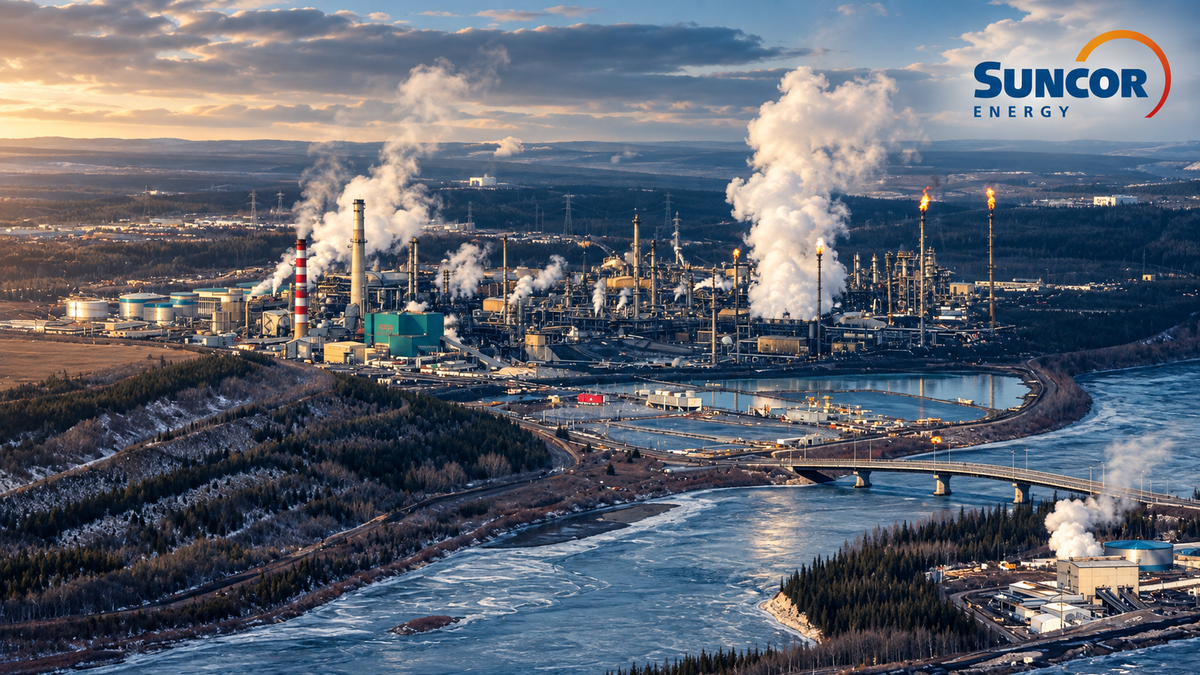
In the early 1960s, producing oil commercially from the bitumen deposits of northern Alberta remained an industrial experiment. The resource was enormous, but turning oil-bearing sand into crude at scale required something very different from drilling a conventional oil field. Sun Oil committed almost a quarter of a billion Canadian dollars to the Great Canadian Oil Sands project at Fort McMurray, at the time the largest single private investment in Canadian history and an undertaking described as the “biggest gamble in history”. Construction began in 1964. Three years later, a C$240 million plant capable of producing 45,000 barrels a day was complete.
That plant became the industrial foundation of what is now Suncor Energy. Great Canadian Oil Sands was combined with Sun Oil’s other Canadian operations to form Suncor in 1979, but something more enduring than the corporate name had already been created. Oil had begun flowing from a resource that did not behave like most of the upstream assets familiar to international oil companies. The facilities built to exploit it would be modified, expanded, repaired and integrated with new infrastructure rather than simply depleted and abandoned as a conventional field reached the end of its life.
The longevity can be difficult to appreciate until it is made physical. Eight coke drums installed in Suncor’s original Upgrader 1 in 1967 were only recently replaced. The new drums are each 98 feet high and weigh about 270 tonnes, and the replacement formed part of an approximately C$1 billion programme designed to extend the life of the upgrader by another 30 years. Industrial equipment installed when Lyndon Johnson was in the White House was still relevant to Suncor’s economics more than half a century later.
Oil sands should therefore not be thought of simply as another form of upstream oil production. At Suncor’s Base Plant north of Fort McMurray, enormous mines feed extraction plants before bitumen passes through upgrading facilities capable of producing synthetic crude. Base Plant today contains two operating mines and two upgraders with approximately 350,000 barrels a day of combined capacity. At in-situ operations such as Firebag, steam is injected underground to mobilise bitumen without open-pit mining. Around both systems sit water treatment, power generation, storage, pipelines, tailings facilities, utilities and a large inventory of fixed industrial equipment.
It is upstream oil and gas, but it also resembles mining, refining and heavy manufacturing. A deepwater development can require billions of dollars and operate for decades, but ultimately the reservoir declines and the installation is decommissioned. Oil-sands economics are more heavily shaped by an enormous resource feeding infrastructure that can itself remain economically useful for generations. Once the major investment has been made, shareholder value depends not only on the quality of the resource but on how well the industrial machine is run: equipment availability, maintenance, steam efficiency, mine performance, turnaround execution, upgrading utilisation and the removal of bottlenecks.
For much of Suncor’s development, that industrial identity was relatively clear. It pioneered the commercial oil sands, expanded its mines and upgrading operations and developed in-situ production while also building downstream integration. Then in 2009 Suncor became a much broader company.
Petro-Canada changes the company
The merger with Petro-Canada was one of the defining transactions in Canadian energy. Former Suncor shareholders emerged with approximately 60% of the combined company and Petro-Canada shareholders 40%. At completion, the new Suncor had a market capitalisation of around C$54 billion and was one of the largest energy companies in North America.
Petro-Canada brought much more than additional oil-sands exposure. It had conventional exploration and production assets, substantial offshore operations in eastern Canada, international production, refining and marketing, and the Petro-Canada retail network. The combination created a globally competitive integrated company with oil sands at its core but conventional production and a broad downstream business around it.
There was considerable strategic logic to that model. Integration gave Suncor options unavailable to a standalone producer. Crude could be upgraded, transported, traded, refined and sold through a national fuel network, which later proved particularly valuable when Western Canadian crude differentials became extreme. Petro-Canada also added scale, diversification and a much broader set of opportunities through which management could grow the company.
It also meant Suncor was no longer simply an oil-sands specialist with downstream integration. Senior executives now had businesses spanning mining, in-situ oil sands, upgrading, conventional and offshore upstream, refining, retail, logistics and trading. The company had become larger and more capable, but also more complex. More businesses competed for capital, board time and executive attention.
For much of the following decade, there was still plenty to build. Firebag expanded. Suncor increased its exposure to Syncrude. Fort Hills became a major new mining development. Hebron came onstream offshore Newfoundland. Large projects and transactions remained central to the value proposition.
Those activities naturally carry visibility inside any corporation. A multibillion-dollar project has a name, a budget and a start-up date. An acquisition has a price, advisers, negotiations and promised returns. Successful executives can point to the development they delivered or the transaction they completed, and boards understandably devote considerable time to decisions where the financial consequences can be immediate.
By the end of the 2010s, however, the nature of the job was changing. Fort Hills and Hebron had both moved into production. Suncor’s 2018 annual report said that, following their completion, reliable cash-flow growth would increasingly depend on operational excellence and deploying technology to improve existing operations. The same report emphasised improved productivity, reliability and lower costs as the way to extract maximum value from the asset base.
Suncor had spent years building an extraordinary industrial system. Increasingly, it needed to become exceptional at operating it.
Value without a corporate event
The work required by a mature industrial asset can look very different from the work required to create it. The mine has to move ore next year much as it did this year. Steam has to be generated at Firebag. Water has to be treated. The upgrader has to remain available. Refineries need turnarounds. Pumps, valves, shovels, pipes and compressors have to be inspected and maintained. Thousands of activities have to happen at the correct time, often without interrupting production.
A large part of successful operations therefore produces no dramatic event. Equipment does not fail. A shutdown finishes when expected. A plant runs a little longer between maintenance periods. A bottleneck disappears. Utilisation moves higher.
It is low-visibility, compounding work. A small improvement in utilisation across an asset expected to operate for decades can generate millions of additional barrels through infrastructure that has already been built. A successful debottleneck may create high-margin production without another conventional megaproject, while better maintenance can increase availability and reduce disruption year after year.
Corporate incentives do not always align neatly with that form of value creation. It is relatively easy to identify the executive responsible for completing an acquisition or cutting hundreds of millions of dollars from a cost base. It is harder to identify the person responsible for a maintenance organisation becoming steadily more capable over several years.
Ambitious executives do not need to be behaving irrationally for that to create a problem. They will naturally seek assignments where responsibility is visible and achievement can be demonstrated. Corporate development, commercial roles, international expansion and major projects offer those opportunities. Mature operations can be economically crucial while appearing less transformational.
A company that has grown by repeatedly building things can therefore reach a point at which its economics change before its organisational instincts do.
Companies do not create value by doing what is most noteworthy to executives. They create value by allocating attention, people and capital to the activities with the highest economic consequence.
Management attention is itself a scarce form of capital. Companies reveal how they allocate it through the people they promote, the roles that attract their strongest executives and the achievements celebrated internally.
Cost reduction can be especially attractive because the outcome is immediate and measurable. A programme can promise hundreds of millions of dollars of savings next year. Improving maintenance capability may initially require expenditure and only become apparent later through higher utilisation, fewer unplanned outages and longer asset life. Both may be labelled efficiency, but they are not necessarily economically equivalent.
By the beginning of the 2020s, Suncor’s operating performance was giving investors increasing reason to question whether the organisation was extracting enough from the asset base underneath it.
Problems accumulate
The deterioration did not take the form of one disastrous decision. Fort Hills suffered operating difficulties. Costs remained under pressure. Elliott Investment Management would later point out that Suncor missed the low end of its upstream production guidance in each of 2019, 2020 and 2021. Relative performance weakened even as the oil-price environment recovered.
More seriously, Suncor developed an increasingly troubling safety record. Workers and contractors lost their lives, and official investigations found specific failures in the way work had been planned and executed.
In January 2021, a worker operating a bulldozer died when the machine broke through ice on a tailings pond. Suncor later pleaded guilty, as prime contractor, to failing to coordinate and oversee the work so that workers were not exposed to the hazard. The Alberta proceedings recorded that available ice measurements had not met the minimum thickness required by Suncor’s own safe-work plan. In a separate fatality in July 2022, a heavy equipment technician was struck by equipment that fell while suspended during shovel maintenance. Suncor pleaded guilty to a failure to guard sharp edges to prevent damage to rigging; two contractors pleaded guilty to separate failures involving training and hazard assessment.
The involvement of contractors in those incidents should not be confused with an argument against contracting. Oil and gas operations around the world rely heavily on specialist contractors to execute maintenance, shutdowns and complex technical work, and contractors can possess capabilities equal to or better than those retained inside an operating company. What matters is how the work is governed: clarity of responsibility, competence, supervision, control of interfaces and the operator’s ability to oversee activities for which it remains accountable.
Suncor was also undergoing significant organisational and financial restructuring. The pandemic and collapse in oil demand forced most oil companies to act aggressively in 2020. Suncor reduced annual operating costs by C$1.3 billion, about 12% from 2019, and cut capital spending by C$1.9 billion, around 33% from the midpoint of its original guidance. Later that year it announced plans to reduce its workforce by 10% to 15% by mid-2022 as part of a broader effort to improve free funds flow and efficiency.
There is no official investigation or credible published evidence establishing that those cost reductions caused Suncor’s subsequent fatalities. The Alberta findings identify specific failures in hazard control, coordination, training and rigging rather than a causal chain running back to the 2020 restructuring. Elliott later offered a broader explanation, arguing that production misses, costs and safety failures reflected a slow-moving and overly bureaucratic corporate culture, but that remained Elliott’s diagnosis rather than the conclusion of a safety investigation.
Large cost programmes in safety-critical industries still pose difficult governance questions. Management can model how much expenditure will disappear and state that safety and reliability will be protected. Much harder to quantify are gradual changes in experience, supervision, institutional knowledge, contractor oversight or the resilience of the organisation when several things go wrong at once.
Suncor itself had already started responding. In 2021 it realigned parts of the organisation to strengthen operational expertise and created a centralised operational risk-management function. Its subsequent safety-improvement programme included stronger frontline leadership, more standardised processes and changes to the organisation and supervision of contractor-heavy work.
By 2022, however, the performance gap was too large to remain an internal management problem.
A correction becomes unavoidable
Elliott went public in April 2022 with an economic interest of approximately 3.4% in Suncor. Its campaign argued that the company had valuable assets but had lost the performance culture that once distinguished it, citing repeated operational challenges, missed production goals, high costs and safety failures. Elliott estimated that more than C$30 billion of value could be unlocked and suggested the shares had more than 50% upside.
The importance of Elliott in the Suncor story is not that an activist investor somehow knew how to run an oil-sands mine or an upgrader. Its intervention demonstrated that external investors had concluded the company’s problems were no longer explicable simply by commodity prices or the disadvantages of Canadian oil. Other producers faced many of the same external conditions. Suncor’s own performance had become part of the valuation problem.
Mark Little stepped down as CEO in July 2022. In announcing the change, board chair Michael Wilson said Suncor had to acknowledge where it had fallen short in safety and operational excellence and recognise the need for change. Kris Smith, previously head of Downstream and an executive with earlier Oil Sands roles, became interim CEO.
Smith’s period in charge belongs in the story because organisational recoveries rarely start on the exact date a permanent CEO arrives. Suncor was already working through its safety plan, strengthening operational leadership and stabilising performance. The board also reached an agreement with Elliott that brought three new independent directors onto the board and placed two of them on the CEO search committee.
The eventual appointment of Rich Kruger nevertheless gave the next phase a distinctive character.
Kruger had spent nearly 40 years in the energy industry, much of it with ExxonMobil. He had held upstream and downstream positions around the world and eventually became president of ExxonMobil Production Company, responsible for the group’s global producing operations. From 2013 until his retirement in 2019 he was chairman, president and CEO of Imperial Oil, giving him direct experience of the Canadian oil sands as well as refining and marketing.
Suncor had hired an operator with deep experience of exactly the kind of long-life industrial system sitting at the centre of the company.
Running the system
One of the clearest examples of the approach that followed comes from Firebag, Suncor’s large in-situ oil-sands operation.
At Suncor’s 2024 business update, Kruger described the approach as “industrial engineering”. Management did not treat Firebag’s historical nameplate capacity as a fixed ceiling. Instead, teams examined the system component by component to identify what was constraining production at a particular point in time. Once one constraint was removed, the next became visible.
Water handling was one constraint. A relatively small piping change helped remove it. Another bottleneck involved pressure-relief capacity and was addressed by adding equipment. The process did not require discovering another field or sanctioning another Firebag-sized project. By early 2025, Suncor said this continuing work had added around 35,000 barrels a day at Firebag over two years without conventional growth investment.
The resource itself is not the immediate constraint at Firebag. Suncor describes decades of remaining resource. The task is to extract more from the expensive surface infrastructure already in place by improving steam reliability, water handling and the other pieces that determine how much bitumen the system can process.
Portfolio decisions increasingly supported the same industrial logic. Suncor assumed operatorship of Syncrude in 2021, an asset in which it owns 58.74%. Syncrude has gross capacity to convert about 350,000 barrels a day of bitumen into synthetic crude, and Suncor described taking over operations as a means of increasing regional integration, efficiency and competitiveness.
Fort Hills moved further in the same direction. Suncor bought Teck’s 14.65% interest in early 2023 for C$712 million, lifting its ownership to 68.76%. Later that year it acquired TotalEnergies’ remaining 31.23% interest for C$1.468 billion and became sole owner. The transaction added production and reserves, but Kruger’s stated rationale also included securing long-term bitumen supply for Base Plant’s upgraders and pursuing greater regional synergies across the oil-sands system.
Simplification does not necessarily mean selling assets. Fragmented ownership of a physically integrated system can constrain what an operator can do. Buying the rest of an asset may simplify the business if it increases control over feedstock, infrastructure and operating decisions.
Kruger also cut costs. Suncor removed approximately 1,500 employee positions in the second half of 2023, making it difficult to sustain a simplistic narrative in which earlier management cut too deeply and the turnaround consisted of spending more money.
A well-run industrial company should be capable of lowering structural costs while simultaneously becoming safer and more reliable. Some spending supports essential capability; other spending reflects duplicated processes, complexity or inefficiency. The job of management is to know the difference.
Suncor’s subsequent performance suggests something material changed.
The operating evidence
Safety improved first and continued improving. Suncor recorded what it described as its best overall safety performance since the Petro-Canada merger in 2023, including no life-altering or life-threatening injuries and an almost 50% reduction in lost-time incidents. In 2024, lost-time injury frequency fell another 25%, while the process safety event rate declined by 32% and reached what Suncor described as its best recorded level. By 2025 the company reported its safest year on record for the third consecutive year, with lost-time and process-safety events down about 70% compared with 2022.
The operating numbers moved in the same direction. Upstream production averaged 745,700 barrels a day in 2023, increased to 827,600 in 2024 and reached a record 860,200 in 2025. Combined upgrader utilisation rose from 92% in 2023 to 98% in 2024 and 99% in 2025. Refinery throughput increased from 420,700 barrels a day in 2023 to 465,000 in 2024 and 480,300 in 2025.
The comparison with 2022 helps separate commodity prices from the physical performance of the company. WTI averaged US$94 a barrel in 2022. Suncor’s upstream production averaged about 743,000 barrels a day and refinery throughput about 433,000 barrels a day. By 2025 WTI averaged only US$65, yet Suncor was producing 860,200 barrels a day, its upgraders were running at 99% utilisation and its refineries were processing more than 480,000 barrels a day.
Suncor naturally generated more cash per barrel in the exceptional commodity environment of 2022. What improved subsequently was the machinery beneath the commodity exposure.
The balance sheet changed materially as well. Suncor ended 2022 with C$13.6 billion of net debt. By the end of 2025 that had fallen to C$6.3 billion, and at 30 June 2026 it stood at C$4.5 billion. The company had about 1.17 billion common shares outstanding by the end of July 2026 after continuing its repurchase programme.
The equity market rewarded the change. Suncor closed at C$42.16 on 27 April 2022, the day before Elliott made its campaign public. On 9 September 2026 the shares closed at C$95.29. The price had therefore risen by 126% before including more than four years of dividends.
None of that proves that every dollar of appreciation came from Kruger, Elliott or improved maintenance. Canadian oil equities have been reappraised. Crude prices, differentials and refining margins have moved. Suncor made acquisitions and disposals and benefited from its integrated model.
The internal evidence is still strong. The same oil-sands system was producing more, processing more and operating more reliably while safety outcomes improved. Debt fell and fewer shares remained outstanding to divide the resulting cash flows among.
Suncor had become materially better at turning its asset base into shareholder value.
What boards allocate
Boards naturally spend considerable time on decisions that look strategic: acquisitions, disposals, new basins, major developments and portfolio shifts. They should. A bad acquisition can destroy billions of dollars very quickly, and a poorly designed project can consume capital for years.
Operational underperformance can destroy comparable value without one identifiable decision ever appearing in a board paper. An upgrader running persistently below its potential does not announce a multibillion-dollar write-off each year. Lost production arrives through outages, constraints and maintenance events, while a maintenance organisation can gradually lose capability without one moment at which someone can say that value was destroyed.
This changes what a board needs to think about when it considers allocation. Financial capital is only one scarce resource. Management attention is another.
Where do the company’s most ambitious executives want to work? Which assignments lead most reliably to promotion? Which functions attract the strongest people? Does success in operations carry the same internal status as executing a large deal or running a commercial initiative? Has the company’s conception of an impressive executive evolved as its asset base has matured?
Those questions are particularly relevant in businesses where the economic centre can become familiar precisely because it has been successful for so long.
The same scrutiny should apply to cost programmes. Removing cost can create genuine value and Suncor’s turnaround provides evidence that lower structural cost is compatible with stronger safety and reliability. A board still needs to understand whether a proposed saving removes waste or removes capability whose economic value only becomes visible later.
Suncor’s fatalities should not be used to imply a causal relationship that official investigations did not find. The wider governance question remains valid: when management presents a major restructuring and says critical operational and safety capabilities will be preserved, what evidence allows the board to test that assertion rather than simply accept it?
Contracting creates a similar requirement. Specialist contractors can operate complex industrial facilities exceptionally well. What cannot be contracted away is the responsibility to understand how the work is governed, where accountability sits, whether interfaces are controlled and whether the organisation retains enough technical competence to know if the system is working.
Suncor ultimately made its correction, but Elliott’s arrival raises one final question. Why did an external activist have to become involved before the scale of the problem was addressed?
A well-functioning governance system has several earlier lines of defence. Management should understand where the company’s economic engine resides, even when other parts of the portfolio offer more visible opportunities. The CEO should recognise when the organisation has moved from a period in which value is created primarily by building new assets to one in which the greater prize lies in operating mature assets exceptionally well.
The board should test whether the organisation has made the same transition. Succession, incentives, career pathways and the allocation of senior talent should reflect what drives economic value rather than simply what attracts corporate attention.
Shareholders also have a role. Long-term owners should be capable of separating commodity-price performance from operating performance and identifying when a company is producing weaker outcomes than the quality of its assets or its peers would suggest. An activist can accelerate a correction, but it should not be necessary for one to identify where a company’s value actually comes from.
Suncor began with one of the great industrial gambles of the twentieth-century oil business. Over the following half century, that gamble became a vast system of mines, steam operations, extraction plants, upgraders, pipelines and refineries capable of producing for generations. As the company expanded and diversified, the nature of value creation gradually changed. Building the next major asset became less important relative to extracting more from the assets already there.
The organisation eventually appears to have caught up with that reality.
At Suncor, those activities increasingly involve work that will look familiar again next year: maintaining equipment, improving processes, supervising operations, removing constraints and making an enormous industrial system slightly better than it was before.
There may be no ribbon cutting, but for Suncor shareholders that's irrelevant.