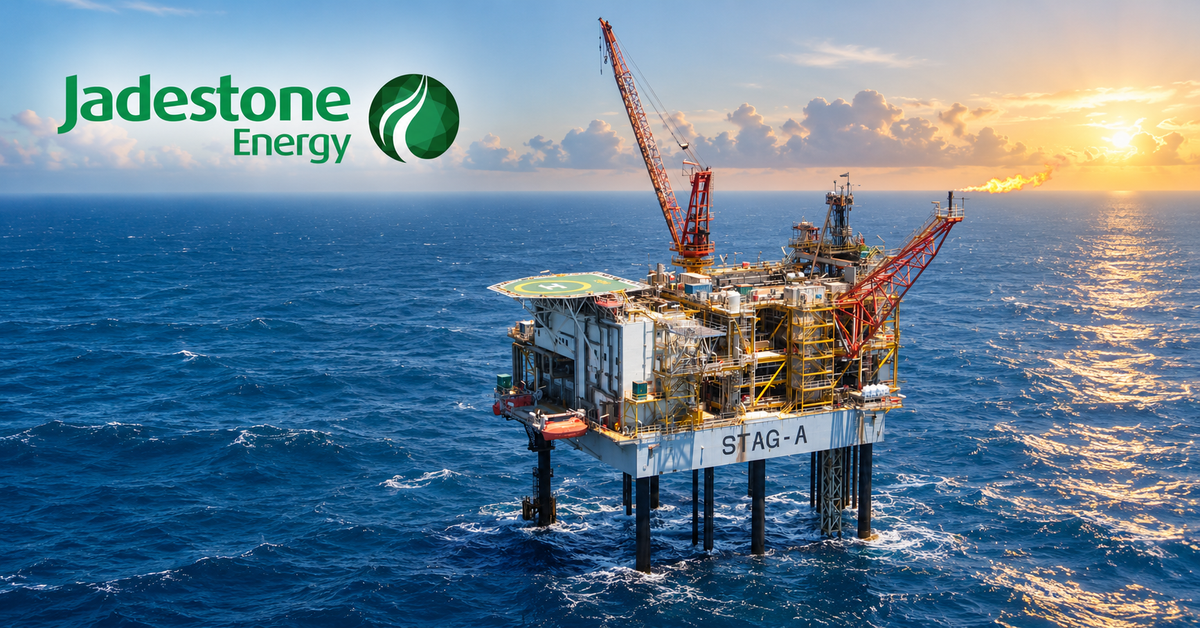
Jadestone Energy is an Asia-Pacific upstream oil and gas company listed on AIM, with a market capitalisation of around £200 million and production of around 17,000 barrels of oil equivalent a day. It has producing assets in Australia, Malaysia and Indonesia, alongside gas developments in Vietnam, with a portfolio spanning operated and non-operated interests, mature offshore oilfields and newer gas production.
The company has changed considerably over the past decade, but the most useful place to begin this story is the middle of 2022. By then Jadestone had completed the first major phase of its transformation from a small acquisition vehicle into a substantial regional producer, and the business looked financially and operationally stronger than at any previous point in its history.
In its 1H22 financials, Jadestone reported $161.6 million of cash and no debt. Production had risen above 20,000 barrels of oil equivalent a day, oil prices were above $100 a barrel, and the shares, admitted to AIM at 35p in 2018, had traded close to 95p. Jadestone was financially stronger than it had ever been, and shareholders had good reason to believe in what management had built.
The main architect of that business was Paul Blakeley, Jadestone’s chief executive. Blakeley had spent more than twenty years at Talisman, initially running its North Sea business and later its Asia-Pacific and Middle East operations. His career had a strong operational foundation, including drilling and field operations, but over time he had also become an experienced builder of upstream businesses. He knew the Asia-Pacific asset market well, had an extensive industry network and had spent years finding opportunities, negotiating transactions and getting deals completed across different countries and counterparties.
That capability was central to what Jadestone had been created to achieve. The strategy was to acquire assets larger companies no longer regarded as central, apply focused management and investment, and use the resulting production and cash flow to build a larger regional business. Blakeley had seen versions of that model work at Talisman, and several colleagues who joined him at Jadestone shared the same experience. His task was not simply to inherit a portfolio and operate it efficiently. He had been brought in to build one.
The first transaction that gave the strategy substance was Stag. In 2016 the company, then called Mitra Energy, agreed to buy the producing Stag oilfield offshore Western Australia from Quadrant Energy and Santos for $10 million. Stag gave the business meaningful production and cash flow and, after operatorship transferred, allowed Blakeley’s team to demonstrate that it could run an offshore oilfield rather than simply own an interest in one. That operating base gave the company something tangible from which a much larger equity story could be built.
Jadestone was already quoted in Canada when it joined AIM in August 2018, so its London flotation was technically an admission accompanied by a substantial equity placing rather than a conventional IPO. For London upstream investors, however, it was a significant new company coming to market. Jadestone raised around $110 million from new and existing institutional shareholders, with the capital principally intended to help fund the acquisition of Montara from PTTEP. Stag had provided production, cash flow and operating credentials; the London financing gave Jadestone the means to take a much larger step.
Montara, a producing offshore Australian oil project, completed in September 2018 and transformed Jadestone’s scale. The company then continued broadening its regional footprint. It acquired the Lemang production-sharing contract in Indonesia in 2020, bought a package of producing offshore Malaysian assets from SapuraOMV in 2021, and already held the Nam Du and U Minh gas discoveries offshore Vietnam. The transactions differed in size, maturity, counterparties and geography, but together they demonstrated that Blakeley and the team around him could repeatedly find assets and get deals done.
By 2022 Jadestone was therefore no longer a business dependent on one or two opportunistic acquisitions. Stag and Montara formed a mature Australian oil base, Malaysia added another source of producing barrels and opportunities for infill drilling, while Indonesia was becoming the location of Jadestone’s next major organic development. The Lemang contract contained the Akatara gas field, which was not yet producing. In June 2022 Jadestone took FID on the development, committing to build the gas-processing plant and associated infrastructure required to bring the field onstream, with first gas then expected in 2024.
Akatara was strategically important because it showed that Jadestone was not simply accumulating ageing oilfields. The development offered contracted gas revenues, relatively low operating costs and a newer source of production that could reduce the company’s dependence on mature Australian assets. Management was using the cash generated from the existing portfolio to build a broader business with different types of production and revenue, and at that point there was little reason for shareholders to regard that as anything other than a sensible evolution of the strategy.
The first major disruption to that considerable progress came at Montara in June 2022. During a routine transfer of crude between tanks on the Montara Venture FPSO, oil was observed on the sea surface beside the vessel and production was stopped. Inspection identified a hole in the base of one crude-oil tank. Jadestone’s shares fell sharply when the problem became public, but the market did not initially treat the event as evidence that the company or its strategy was broken. The shares subsequently recovered as investors regarded the problem as serious but repairable, which was a reasonable interpretation of the information then available.
Management displayed similar confidence. In August 2022 Jadestone launched a share-buyback programme and continued purchasing stock even after another defect, this time in a ballast tank, required Montara to shut down again. By early 2023 the company had spent almost $18 million repurchasing 20.2 million shares at an average price of around 76p. Whatever investors might infer from management commentary, committing cash to repurchase equity was a tangible expression of the company’s view that Montara was a temporary setback and that Jadestone remained undervalued.
There was some history behind the physical problem. Australia’s offshore regulator had already required Jadestone in 2021 to improve aspects of corrosion management at Montara. That did not mean the specific tank failures of 2022 were predictable, and the asset had an operating organisation responsible for inspecting, maintaining and safely running the facility. What mattered increasingly was how long Montara remained unavailable and what else Jadestone was committing to while one of its principal sources of production and cash flow was offline.
In July 2022, only weeks after the first Montara leak, Jadestone agreed to acquire BP’s 16.67% interest in the Cossack, Wanaea, Lambert and Hermes oilfields offshore Western Australia, usually shortened to CWLH. These were already producing fields, adding more than 2,000 barrels a day of net production, and the headline purchase price was only $20 million. The apparent cheapness was real, but incomplete, because Jadestone also assumed its share of future decommissioning obligations and committed to fund $82 million into an abandonment trust, including $41 million when the transaction completed in November 2022.
CWLH subsequently performed well and became an important part of Jadestone’s Australian portfolio. The transaction nevertheless illustrates an important feature of mature-asset acquisitions. The cash paid to a seller can be modest while the buyer simultaneously accepts substantial future costs associated with plugging wells and removing infrastructure once production ends. Those obligations may lie years in the future economically, but the arrangements put in place to secure them can consume cash much sooner.
Meanwhile Akatara had moved from investment decision into construction, so Jadestone was spending money on a development that would not generate revenue until it was completed. The company was also investing in drilling at Stag and elsewhere in the portfolio. Montara, which had been expected to contribute cash through this period, remained offline from August 2022 until March 2023. What had begun as an engineering problem on one asset was therefore occurring alongside a much larger programme of investment across the company.
Another acquisition followed while Montara was still shut down. In early 2023 Jadestone completed the purchase of a 9.52% interest in the Sinphuhorm gas field in Thailand for about $28 million. Unlike Akatara, Sinphuhorm was already producing, so there was no major development programme to fund before revenues arrived. It was a low-cost gas asset selling into an established market and ultimately proved to be a good investment: Jadestone later sold the interest for more than it had paid after also receiving substantial cash distributions during its ownership.
The timing nevertheless added another call on the company’s finances. Jadestone was building Akatara, funding drilling in Malaysia and Australia, meeting abandonment commitments at CWLH and coping with an extended shutdown at one of its most important producing assets. It used interim borrowing to help fund the Thai acquisition before its permanent bank facility was available. Sinphuhorm itself was attractive, but it increased the amount Jadestone needed to finance while other parts of the portfolio were consuming cash rather than producing it.
The scale becomes easier to appreciate in aggregate. Jadestone’s own financing material later showed roughly $325 million of expenditure across the second half of 2022 and 2023, encompassing development spending, drilling, acquisitions and other investment. That compares with the $161.6 million of cash and zero debt reported in June 2022, while Montara unexpectedly stopped contributing production. Akatara promised newer, contracted gas production; Malaysian drilling offered attractive returns; CWLH added producing barrels; Sinphuhorm was low cost and immediately cash generative. There was a reasonable investment case behind each commitment.
Jadestone’s finance leadership was also changing during this period. Dan Young left the CFO role in April 2022 and Bert-Jaap Dijkstra joined in September, by which point Akatara had been sanctioned, Montara had suffered its first failure and the initial CWLH acquisition had been agreed. Dijkstra arrived with substantial financing, treasury and capital-markets experience, but much of the investment programme already under way had been set in motion before he joined.
By May 2023 Jadestone had arranged a new $200 million reserve-based lending facility. RBLs are common in upstream oil and gas: banks lend against the reserves and expected future cash generation of an agreed group of assets, with borrowing capacity reassessed as those assets produce and their economics change. Montara’s operating performance therefore had consequences beyond the barrels temporarily lost. Continued disruption could affect the financing structure that was supporting the wider company.
By June 2023 Jadestone knew that its financial cushion had become too thin. It raised fresh equity at 45p a share and arranged additional liquidity to protect the balance sheet against what it described as a reasonable downside scenario. The share price tells part of the story. A year earlier Jadestone had traded close to 95p, while management had subsequently bought shares back at an average of around 76p. By the time new capital was required, shareholders were being asked to provide it at 45p. Confidence had already weakened materially before the next Montara problem arrived.
The financing was intended to carry Jadestone through the heavy investment period rather than signal the abandonment of its growth plans. The reasoning was understandable. Montara could return to production, Akatara could be completed, Malaysian drilling was performing well, Sinphuhorm was already producing cash and CWLH was contributing. If those things happened broadly as expected, Jadestone could move through a period of elevated spending and emerge as a larger and more diversified company.
In late July 2023, only four months after Montara had restarted, another problem triggered a shutdown while a different tank was investigated. Jadestone’s shares fell by roughly a third in a day. The incident did not create the company’s financial strain, because the June financing had already demonstrated that, but it further changed the way investors viewed the reliability of Montara and the amount of uncertainty being carried by the wider business.
Shareholder confidence deteriorated in stages rather than disappearing at the first sign of trouble. Jadestone had earned substantial trust through several years of execution, and investors initially gave management the benefit of the doubt. As the outage became prolonged, new integrity problems appeared and fresh equity was required, the market progressively changed its view. This later mattered inside the company as well as outside it because shareholder outcomes became part of the board’s own assessment of management performance.
There were already signs during 2023 that Jadestone’s organisational structure was beginning to change. The company announced plans to create a chief operating officer role and to refresh the board with additional experience. It had grown substantially in only a few years, and the breadth of the portfolio was increasingly different from the business that had originally been assembled around Stag and Montara.
Even then, Jadestone continued to find opportunities. In November 2023 it agreed to acquire another 16.67% interest in CWLH. The headline consideration was only $9 million for a material increase in production and reserves, and management could point to strong field performance and low decline rates. Yet the transaction also required Jadestone to fund up to roughly $102 million into the CWLH abandonment trust during 2024.
The second CWLH acquisition came after the June equity raise and the further Montara shutdown, while Akatara was still being completed. It was another transaction in which the headline purchase price told only part of the financial story. Jadestone was adding further producing assets at the same time as the cash demands associated with the broader portfolio were becoming increasingly visible.
By early 2024 the nature of the Australian operating challenge had also become clearer. Jadestone acknowledged that life-of-field costs at both Montara and Stag were higher than previously expected because of the repair and maintenance required to keep the facilities operating safely and reliably. The Australian problem was therefore no longer confined to one unfortunate tank failure. Maintaining mature offshore production was itself going to require more cash than previously assumed.
Yet 2024 also demonstrated why the period cannot be understood simply as a failed growth strategy. Akatara was completed and began commercial gas sales. Malaysia was performing strongly. CWLH was contributing. By December Jadestone announced that group production had exceeded 25,000 barrels of oil equivalent a day for the first time, meaning that several investments made during the period of greatest financial pressure were beginning to deliver the production and diversification originally expected from them.
In the same announcement, Paul Blakeley left Jadestone with immediate effect. The timing was striking. The board was changing the chief executive just as significant parts of the portfolio he had assembled were beginning to perform. Jadestone’s subsequent annual report said that during the second half of 2024 the board had reviewed the performance of the group and management team against targets, considered resulting shareholder outcomes and share-price performance, consulted material shareholders and concluded that a change in management was required.
The management transition had already been preceded by wider organisational change. The board was being refreshed, the operating structure strengthened and senior responsibilities adjusted as the company evolved. Adel Chaouch, who had joined as an independent director during 2024, became executive chairman following Blakeley’s departure while Jadestone searched for a permanent new chief executive.
The reset that followed can be judged more usefully through decisions than changes in corporate language. One of the clearest was Sinphuhorm. Jadestone sold the Thai interest in 2025 even though it had performed well and generated a strong return, with the proceeds primarily used to reduce debt. The asset had not become poor; management had decided that releasing the capital tied up in it and strengthening the balance sheet was more valuable to the company at that point.
Mitch Little became chief executive in June 2025 after more than thirty years at Marathon Oil, where his later responsibilities included worldwide operations and development. Operational reliability, costs, cash generation and balance-sheet strength became prominent priorities. The legacy operating problems nevertheless remained. In September 2025 NOPSEMA issued another direction concerning Montara’s hull integrity, requiring further work around repairs and integrity management. Changing management did not alter the physical condition of mature offshore infrastructure.
Jadestone’s experience in 2026 provides a useful test of what had changed. Cyclone damage interrupted production at Stag, while a separate subsea issue delayed the restart of CWLH, forcing the company to reduce full-year production guidance from 18,000–21,000 to 16,000–18,000 barrels of oil equivalent a day. These were material operating problems, but they did not lead to a repeat of the financing pressure experienced in 2023. Insurance responded at Stag, other parts of the portfolio continued generating cash and net debt had fallen sharply from the levels reached during the earlier period.
The market reaction was also much less severe, although by then much of Jadestone’s operational risk was already reflected in a share price that had fallen dramatically from its 2022 highs. The more important difference was therefore not the immediate market response, but that the latest disruptions did not trigger the same financing pressure that had accompanied the problems of 2022 and 2023.
Jadestone also changed the structure of its borrowing. In March 2026 it replaced the RBL with a $200 million senior secured bond maturing in 2031. The bond was heavily oversubscribed, demonstrating that Jadestone retained access to debt capital, but it carried a 12% coupon. The refinancing provided longer-dated funding and removed some of the direct linkage between borrowing availability and individual producing assets that existed under the RBL, although the cost showed that credit investors still required substantial compensation for the risks involved.
Only days ago, another significant change took place around the company. Tyrus Capital, which backed the strategic reset that brought Blakeley into the business in 2016, provided a board representative and remained a major shareholder through the acquisition programme and the difficult period that followed, sold its entire 28.3% holding to Prima Energy, an Indonesian upstream operator. The transaction completed on 3 September 2026. Prima has said it does not intend to make a takeover offer and intends to support Jadestone’s long-term growth.
There is no need to infer a judgement from Tyrus’s decision that the public record does not support. Its significance is that the ownership context around Jadestone has changed alongside management, governance and financing. The financial investor that backed the original build has been replaced by a large regional industry shareholder just as Jadestone begins considering how the next phase of the company should develop.
That next phase already contains a substantial decision. Jadestone owns the Nam Du and U Minh gas discoveries offshore south-west Vietnam, which are undeveloped rather than producing assets. The field development plan was approved in 2026, a gas sales agreement is now in place and Jadestone has booked around 32 million barrels of oil equivalent of initial proved and probable reserves. If successfully developed, the fields could become an important source of contracted gas production and further reduce the company’s dependence on mature Australian oil.
Jadestone is seeking a partner before taking final investment decision rather than simply assuming the full development burden itself. Bringing in another investor would reduce Jadestone’s share of the future upside, but it would also reduce the amount of capital the company itself has to commit and preserve capacity elsewhere in the portfolio. How much Jadestone ultimately retains, and how the project is funded before sanction, will provide useful evidence of how the company now thinks about growth after everything that happened between 2022 and 2024.
Seen in full, the Jadestone story leaves a more sympathetic and more complicated assessment of Paul Blakeley than the share-price performance alone might suggest. He was very good at one of the hardest parts of building an independent upstream company. He found assets, negotiated transactions with major counterparties, raised capital, entered new jurisdictions and assembled a business with genuine regional scale. Several investments made during the period of greatest pressure subsequently delivered operationally, and Sinphuhorm produced a good realised return before it was sold.
The distinction between asset performance and shareholder outcomes is important. Jadestone’s shares traded close to 95p in 2022, subsequently fell below 20p and, despite the recent recovery, remain around 37p. The company may own a broader portfolio today, but shareholders have absorbed a very substantial loss of value along the way. Whatever credit is due for building the underlying business has to sit alongside that outcome.
That changes the diagnosis of what went wrong without making the result less serious. Jadestone was not undone by a string of obviously poor acquisitions made by a management team that could not recognise value. Blakeley largely did what he had been brought into the company to do, and did a significant part of it very well. The difficulty was that the company he built became more complex financially and organisationally than the company with which the journey had begun, and the value created or preserved at individual assets was not enough to protect the equity from what happened at the corporate level.
Blakeley’s background helps explain some of what happened without turning it into a criticism of him, which would be unfair; he was not running Jadestone as a one-man band. His career had been built around drilling, operations, running upstream businesses and later originating and executing transactions. Before Jadestone, he had carried those responsibilities inside a much larger corporate organisation. At Jadestone he had a very different role: chief executive of a listed company, where financing, balance-sheet capacity, capital-markets consequences and shareholder outcomes all sat directly inside the business he was leading.
A strong board should understand the particular strengths of the chief executive it appoints and make sure that the organisation around that person develops as the nature of the company changes. Jadestone needed Blakeley’s ability to build the portfolio, but as that portfolio expanded it increasingly needed equally strong capabilities around corporate finance, treasury, balance-sheet risk and the interaction between multiple commitments. The question was no longer simply whether the next deal worked economically. It was whether all of the commitments already sitting inside the company could be carried safely together.
That responsibility did not belong to the CEO alone. Major acquisitions, development commitments and financing arrangements were corporate decisions subject to board oversight. The board was responsible for the overall risk appetite of the company, and the finance function existed not simply to find money for an agreed strategy but to help determine how much strategy the balance sheet could safely support. If Jadestone ultimately overreached, it was Jadestone that overreached, not one executive acting independently of the organisation around him.
Through 2022 and 2023, Jadestone showed how individually attractive investments can still leave the company carrying them financially exposed. Akatara could be a good development, CWLH a good acquisition and Sinphuhorm a profitable investment, yet the combination still became difficult to finance once Montara stopped contributing the cash flow that had been expected. Development spending, abandonment funding, acquisition payments and operating costs that were manageable on their own were suddenly competing for the same finite financial capacity.
The more revealing failure at Jadestone was not necessarily one of asset selection. It was that the company did not put enough financial and organisational constraint around its growth until the strain was already obvious. By the time the CFO transition had been followed by plans for a COO, a board refresh and a rethink of the way the business was being run, Jadestone had already raised equity, absorbed repeated Montara disruption and taken on another large CWLH funding commitment. The company did adapt, but much of that adaptation came after the consequences of the earlier approach had already reached the balance sheet and the share price.
That also explains why Blakeley’s departure in December 2024 looks less straightforward with hindsight than it might have done at the time. He left just as important elements of his strategy were beginning to deliver operationally. The board may still have been right to conclude that a management change was necessary, particularly after the damage suffered by shareholders, but the history does not support a simple story in which a failed chief executive was removed and a broken strategy discarded. Jadestone kept much of what Blakeley had built and changed the way the company around those assets was being managed.
The board eventually acted while it still had meaningful choices. Jadestone could strengthen its operating organisation, refresh governance, replace management, sell a good asset rather than a distressed one, reduce debt, refinance on longer terms and approach its next major development with a partner rather than automatically carrying the whole investment itself. It never reached the point where creditors completely dictated the strategy or where financial distress removed the company’s ability to decide what it wanted to keep and what it wanted to change.
The harder question is why more of that constraint was not present earlier. Jadestone had deliberately backed a chief executive who was exceptionally good at building an upstream business and finding transactions. As that strategy succeeded, the importance of the counterweight increased. A board that understands its CEO should not merely encourage the capabilities that make that executive valuable; it should also make sure that the rest of the organisation is strong enough to prevent those same capabilities from taking the company further than its financial resilience can safely support.
That may be the most useful way to understand what happened at Jadestone. Blakeley built much of the company he was asked to build, and several of the underlying investments ultimately delivered better operational outcomes than the subsequent share-price history might imply. But the shareholder outcome was still poor. What failed to develop quickly enough was the corporate machinery needed to support that success: the operating depth, financial discipline, balance-sheet protection and board-level constraint required once a small acquisition vehicle had become a much more complicated regional E&P.
Jadestone is now entering another phase with different management, refreshed governance, a different financing structure and a new strategic shareholder. Vietnam will show whether the company still wants to build, which it clearly does, but more importantly how it now chooses to carry the risks that come with building. The lesson from the previous phase is not that growth was wrong, nor that good assets inevitably create good shareholder outcomes. It is that building the assets and building the company capable of supporting them are two different jobs, and Jadestone became better at the first before it had fully completed the second.