Michael O’Leary has never regarded a strong balance sheet simply as protection against things going wrong. He sees it as preserving the ability to take advantage when they do.
After 9/11, with the airline industry in crisis, Ryanair placed a firm order for 100 Boeing 737-800s and took options over another 50. Aircraft demand had collapsed, Boeing was under severe pressure and few airlines were in a position to commit to a major new fleet order. Ryanair was. Its financial strength allowed O’Leary to negotiate from the opposite side of the distress and secure aircraft on highly competitive terms.
Almost two decades later, Covid created another opportunity. In December 2020, as airlines around the world were retrenching and Boeing was recovering from both the pandemic and the grounding of the 737 MAX, Ryanair ordered more, taking its firm order to 210 aircraft.
O’Leary does not simply buy whenever the industry is weak. In 2021 he walked away from negotiations over a further MAX order because he thought Boeing wanted too much. Ryanair could afford to wait for another crisis rather than convince itself that unused financial capacity had to be deployed.
That strength was deliberate. Airlines are full of competitors operating with stretched balance sheets, where a relatively small deterioration in trading can become a liquidity problem. Ryanair chose a different model. It can keep investing and negotiate aggressively while others are defending cash. A strong balance sheet is an offensive capability as much as a defensive one.
Some oil and gas executives understand the same principle; in fairness, most would say they do, and the logic is obvious. Permian Resources has gone further and formalised a “downturn playbook” built around balance-sheet strength and the ability to deploy capital when weaker commodity prices constrain others. Yet oil and gas investors have spent much of the past decade demanding almost the opposite behaviour: stop accumulating capital, stop chasing growth and give surplus cash back to shareholders.
The industry spent years pursuing production, reserves, acreage and corporate scale without consistently creating equivalent value per share. Cash disappeared into drilling programmes and acquisitions, often justified by strategic logic and optimistic synergies. Balance sheets were stretched and companies were left exposed when the cycle turned. Free cash flow replaced production growth as the dominant language of the sector. Dividends returned. Buybacks became central to capital-allocation frameworks. Cash that could not earn an adequate return was expected to go back to its owners.
It was a necessary correction, but there is a risk that a sensible correction becomes too rigid. In a deeply cyclical industry, some of the highest-return opportunities appear precisely when weaker companies have lost the ability to pursue them. Returning every surplus dollar can be just as mechanistic as spending every surplus dollar.
Shareholders should want their money back when management has no sufficiently attractive use for it. They should also recognise that unused financial capacity can itself have value when the people controlling it have proved they can use it well. CEOs and shareholders do not necessarily see the balance sheet in the same way. A diversified investor can receive a dividend and put the money somewhere else. A CEO cannot redeploy the company they run. Their career, influence, reputation and compensation remain tied to it.
A bigger company can mean a bigger job. A strong balance sheet preserves strategic freedom, supports independence and reduces the risk that a downturn forces asset sales, capex cuts or other uncomfortable decisions. Shareholders may happily accept a takeover premium that management would rather never receive. A liquidity crisis can end a CEO’s career. Missing an acquisition that might have worked usually will not. Management can rationally prefer more financial protection than a diversified shareholder would choose.
Some companies go much further in the opposite direction, and PetroEquity Signal has mentioned quite a few of them recently. They load the balance sheet and chase deals in an attempt to outrun deterioration in the existing business. Weak organic performance, declining production, poor reserve replacement or a tired inventory can all be temporarily obscured by an acquisition. The deal adds production, reserves and EBITDA, creates a new strategic narrative and resets expectations around a larger company. Debt or new equity allows management to postpone confronting the weakness underneath.
A shareholder can accept a shrinking company if shrinking creates more value per share. A CEO has much less natural incentive to preside over one. A company that consumes its financial capacity chasing growth in ordinary conditions may then have none left when the genuinely exceptional opportunity appears.
A war chest and financial capacity are not the same thing. A war chest is capital looking for something to buy. Financial capacity is the ability to act if the right opportunity appears, and the ability to do nothing if it does not.
Enough of the warm-up act. Let us talk specifics.
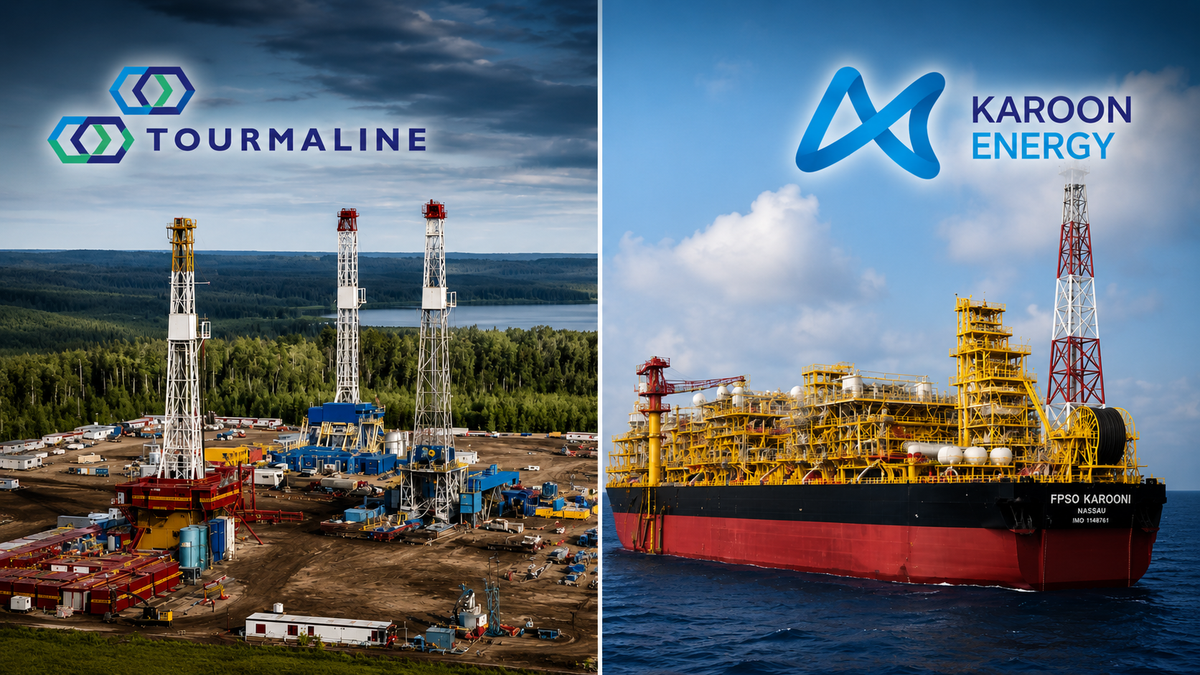
Tourmaline Oil is not particularly well known outside Canada despite having become the country’s largest natural gas producer. Mike Rose founded the company in 2008 following the sale of Duvernay Oil to Shell. He had previously built Berkley Petroleum. Tourmaline subsequently assembled a major position across the Alberta Deep Basin and the Montney in northeast British Columbia, combining organic subsurface development with repeated acquisitions. Rose remains chairman, president and CEO.
Its acquisition history runs through several commodity environments. Shell assets came during the post-2014 downturn. Jupiter Resources was acquired amid the disruption of 2020. Black Swan followed in 2021, Bonavista in 2023 and Crew Energy in 2024. No single transaction explains the company. Tourmaline has repeatedly remained capable of acting while parts of the Canadian industry were constrained, and that did not require a giant cash balance.
The 2020 Jupiter acquisition was funded principally with Tourmaline shares and the assumption of Jupiter debt. The company’s financial capacity consisted of a manageable balance sheet, operating cash flow, borrowing capacity, credible equity and the ability to absorb liabilities without creating a problem of its own.
Nor has Tourmaline used balance-sheet strength as an excuse to keep everything from shareholders. It began paying a regular dividend in 2018 and later added substantial special dividends. In 2022 alone it paid four meaningful specials on top of the regular quarterly dividend. Tourmaline has returned large amounts of capital while preserving its ability to transact. The choice has not been between an empty balance sheet and a corporate war chest.
The current weak North American gas market offers another illustration. Tourmaline is injecting additional gas into storage, deferring activity and delaying part of its northeast British Columbia infrastructure build-out. Planned spending and near-term production growth have been reduced. It has the balance-sheet capacity to spend more and is choosing not to.
That is close to the discipline O’Leary has demonstrated at Ryanair. Financial capacity is useful because it can be deployed aggressively when the economics are exceptional and left alone when they are not.
Tourmaline should not be turned into a perfect case study. Not every acquisition involved a distressed seller. Several used equity. Growing production and reserves does not prove that every deal created value per share, and a strong share price can itself become a powerful acquisition currency. Canadian natural gas has also endured long periods of weak and volatile pricing, which may itself have helped shape Tourmaline’s approach.
Its record nevertheless suggests that capital returns and strategic flexibility do not have to be competing philosophies. A company can return surplus capital without surrendering its ability to exploit the next dislocation.
Karoon Energy approaches the same issue from a less comfortable direction. The Australian-listed company spent much of its history as an explorer. For years it carried substantial financial capacity while looking for an acquisition that would give it meaningful production and cash flow. That is exactly the sort of situation in which shareholders begin asking why the money is still inside the company.
Karoon eventually found Baúna, a producing oil field in Brazil’s Santos Basin being sold by Petrobras. It agreed to acquire the field in 2019 for headline consideration of US$665 million. Covid arrived before completion. Oil demand collapsed, prices fell sharply and financing conditions across the industry deteriorated. Karoon stayed in the transaction and renegotiated it. The revised structure reduced the firm consideration and linked part of the remaining consideration to future oil prices.
The original transaction had contemplated external financing as well as Karoon’s own resources. The renegotiated structure left the company in a much stronger position to complete the acquisition without burdening the balance sheet.
Karoon completed the acquisition in November 2020 and moved from being primarily an explorer to a producing oil company. Years of apparently idle financial capacity suddenly had a purpose.
Baúna became the foundation of Karoon. Subsequent subsurface work and investment improved production, reserves and field life, so not all of the later value can be attributed to the acquisition price. But the transaction shows why apparently inefficient capital can acquire very different value when the external environment changes abruptly.
Three years later Karoon acquired interests in the Who Dat fields and associated assets in the US Gulf of Mexico, using new debt, new equity and existing cash. The shareholder reaction was very different. Some investors wanted more capital returned. Founder Bob Hosking publicly supported the introduction of dividends. Concern centred on dilution, further acquisition-led growth and whether the company’s expanded financial capacity would simply lead to another deal. More than a quarter of shareholders voted against the remuneration report at the 2024 AGM.
Who Dat does not need to be declared a bad acquisition for the debate surrounding it to be of interest here. Its economics will take time to establish. Baúna shows why shareholders might tolerate apparently idle financial capacity. The reaction to Who Dat shows why one successful deployment does not give management a permanent licence to keep and redeploy capital.
The two transactions were not even led by the same CEO. Hosking retired as Baúna completed. Julian Fowles subsequently led Karoon through Who Dat. The balance sheet belongs to the company. The judgement over how to use it belongs to people.
The industry’s capital-allocation debate has also been shaped by the energy-transition period. For much of the past decade, boards and investors were being told that oil demand could peak sooner than expected, that long-duration hydrocarbon investment risked becoming stranded and that capital should be returned rather than committed to growth that might never earn its cost. In that environment, restraint was not just about correcting past excess. It was also a response to a widely held view that the industry itself might be entering structural decline.
That view has become much less certain. Oil demand has proved more resilient than many transition scenarios assumed, while years of constrained upstream investment have raised a different concern: not that companies own too much resource, but that some may eventually discover they preserved too little capacity to replace what they produce or exploit opportunities when they arise. The shareholder-return model remains sensible, but the assumptions that helped push it to its most extreme form deserve to be revisited.
But one formula should not simply replace another. “Return the maximum possible cash” can become as mechanical as “replace every barrel” once was. It works well when management has no better opportunity. It is less obviously optimal when preserving some capacity allows a company to acquire exceptional assets during the next downturn at returns far above those available in normal conditions.
O’Leary has earned considerable freedom because Ryanair shareholders have watched him deploy financial strength when the terms were exceptional and refuse to transact when they were not. Tourmaline has elements of the same model: it has acquired through different parts of the cycle, returned substantial capital and retained the ability to slow investment when conditions deteriorate. Karoon shows how conditional that permission should be. Baúna vindicated patience; the later debate over Who Dat showed that shareholders do not have to extend the same trust indefinitely, particularly when management changes.
Two companies can each have substantial unused financial capacity and offer shareholders very different propositions. In one, the money may increase the probability that management finds a deal because it has money available. In another, it may preserve the ability of a proven capital allocator to wait until somebody else has a problem. The difference will not appear in a leverage ratio.
A strong balance sheet can protect a company when things go wrong. In the hands of the right management team, it can also preserve the ability to take advantage when they do. Sometimes the capital should be returned. Sometimes the option may be worth more.
O’Leary has earned the right to ask shareholders for that flexibility because he has shown them what he does with it. He has used financial strength aggressively when the opportunity was exceptional and left it untouched when it was not. That trust was earned over time.
Oil and gas boards asking shareholders to accept the same trade-off should probably be judged by the same standard.