Equinor’s Best Wind Deal Was a Sale. Its Worst Was a Purchase.
Equinor spent $3.4 billion buying into Ørsted. Eni collected billions selling stakes in Plenitude and Enilive. Two oil companies stood on opposite sides of the minority-stake market, and the results say a lot about capital allocation.

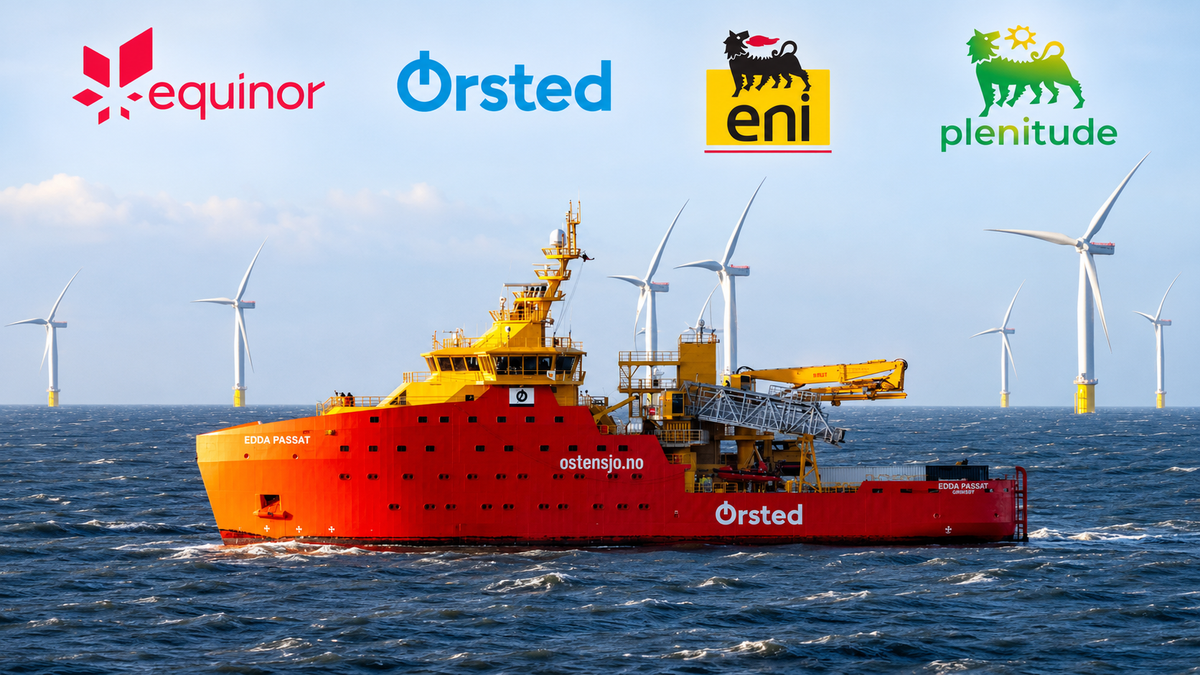
Two European oil companies made opposite bets on minority ownership of transition businesses. Equinor spent billions buying into Ørsted. Eni collected billions selling stakes in Plenitude and Enilive. Their transactions tell a revealing story about capital allocation.
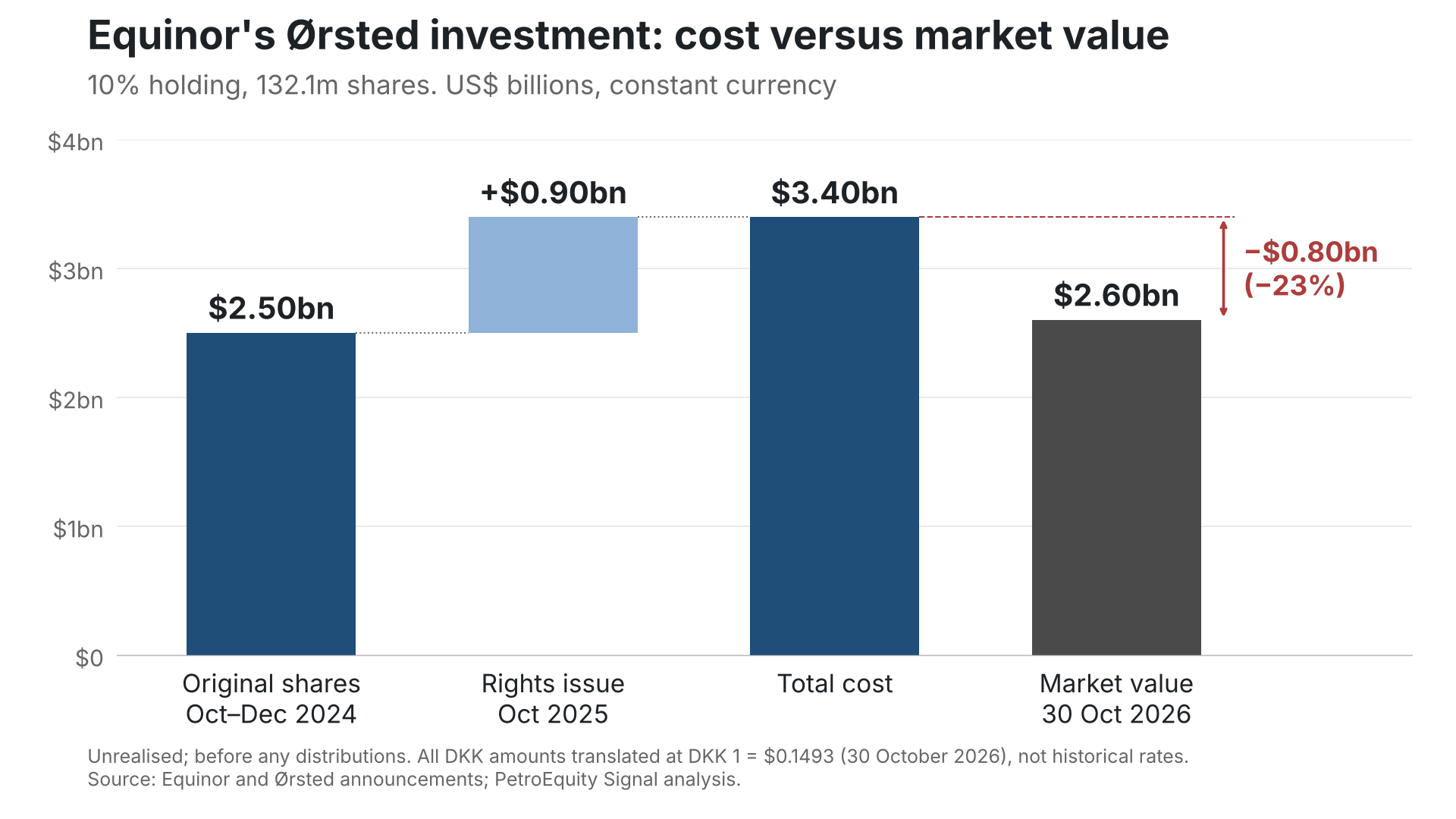
In October 2024, Equinor began building a 10% stake in Ørsted, the Danish offshore wind developer. It acquired its original shares for approximately $2.5 billion at today's exchange rates, then committed another $900 million to support Ørsted's $9 billion rights issue a year later. By the end of October 2026, Equinor's total investment of approximately $3.4 billion was worth $2.6 billion.
During much the same period, Eni was making the opposite trade. It was selling minority interests in Plenitude and Enilive to infrastructure and private capital investors, realising billions in cash proceeds while attracting additional funding for their growth. By October 2026, Plenitude had an implied enterprise valuation of approximately $14.7 billion, with Eni retaining 65%.
Both companies wanted to build businesses beyond oil and gas. Both used partnerships and external capital. But one was buying a minority interest in somebody else's transition business while the other was selling minority interests in businesses it had developed itself.
The difference is more interesting than another argument about whether oil companies should invest in renewables. It raises a question about which side of these transactions their shareholders should want them to occupy.
Equinor knew how to sell offshore wind
The irony is that Equinor had previously demonstrated precisely the commercial judgement that now makes Eni's approach interesting.
In September 2020, Equinor agreed to sell BP a 50% interest in its Empire Wind and Beacon Wind offshore projects in the United States for $1.1 billion. Equinor had acquired the underlying development rights through federal lease auctions at a fraction of that valuation.
The transaction brought in substantial cash, established a market value for the projects and transferred half the future funding obligation to BP. It was a successful monetisation of development rights at a time when investors were prepared to pay heavily for exposure to offshore wind.
Three years later, the economics looked very different. Higher construction costs, financing expenses and difficulties securing sufficiently attractive electricity prices had undermined the assumptions on which the developments were based.
New York regulators refused requests to renegotiate the projects' power contracts. BP recorded substantial impairments, and the companies subsequently separated their interests, leaving Equinor with Empire Wind and BP with Beacon Wind.
Equinor's original sale had protected it from some of the financial consequences of the deterioration. But the project it retained continued to require substantial investment.
In 2025, Equinor recognised $955 million of impairments associated with Empire Wind, comprising $763 million on Empire Wind 1 and $192 million on Empire Wind 2. Its renewables business reported a net operating loss of approximately $1.6 billion for the year, including impairments.
Empire Wind 1 has nevertheless continued towards completion. By October 2026, the project was reported to be approximately 80% complete, with first power expected in the first half of 2027.
The original development economics have changed, but the decision to complete the project must now be judged against its remaining expenditure and prospective cash flows. An impairment does not necessarily mean that abandoning a project would be the better commercial decision.
Equinor's 2020 sale to BP was different. It realised value before the industry's economics deteriorated, transferred risk and preserved capital. That was an excellent example of what an oil company can achieve by selling part of a development rather than retaining the entire exposure.
The company subsequently became a buyer of offshore wind equity.
Ørsted was a minority investment without control
When Equinor acquired its Ørsted stake in 2024, the shares were already trading far below their earlier highs. The company had suffered substantial US project impairments, but remained one of the world's most experienced offshore wind developers, with operating assets and a considerable development portfolio.
There was a plausible investment case. Equinor could gain exposure to an established renewable electricity business without having to develop every project itself. Ørsted's difficulties might also have created an opportunity to buy assets and expertise at a depressed valuation.
The weakness was not necessarily the headline share price. It was the combination of risks Equinor accepted.
The investment was made shortly before the 2024 US presidential election, when the future of American offshore wind development was already politically uncertain. Ørsted had substantial exposure to US projects and significant funding requirements.
Equinor also acquired a minority position without control. The Danish state retained majority ownership of Ørsted, and Equinor initially indicated that it was not seeking a board seat.
That meant Equinor had committed billions to a business whose investment programme, financing and strategic direction it could not determine. The financing risk became visible in August 2025, when Ørsted announced a rights issue of approximately $9 billion.
For Equinor, maintaining its 10% holding required an additional investment of approximately $900 million. The subscription price was equivalent to roughly $9.94 per share, substantially below the prevailing market price.
Equinor subscribed.
The new shares have subsequently performed well relative to their subscription price. But it would be misleading to treat that as a successful second investment independent of the first. The discounted rights issue diluted the economic value of the existing shares, with subscription rights compensating their owners for that dilution.
Equinor's original 42.04 million shares cost approximately $2.50 billion, based on its disclosed average purchase price. Its participation in the rights issue added approximately $900 million. At a 30 October 2026 Ørsted share price equivalent to approximately $19.69, the enlarged holding was worth approximately $2.60 billion against a total investment of approximately $3.40 billion.
That represents an unrealised decline of approximately $800 million, or 23%, on a constant-currency basis, before any distributions.
The investment may yet recover. Ørsted has raised new capital, its development portfolio remains substantial and a recovery in offshore wind economics could improve its valuation.
But Equinor's shareholders have already experienced the consequences of acquiring a passive minority position in a capital-intensive business that subsequently required a major recapitalisation.
There is also a broader capital-allocation question. Equinor's shareholders could have purchased Ørsted shares themselves. They did not need an oil company to provide that exposure on their behalf.
A corporate investment might still be justified by access to expertise, commercial opportunities or strategic influence. In this case, however, Equinor acquired neither control nor a clear route to controlling the risks that subsequently damaged the investment.
And those risks were closely related to the ones already affecting its own offshore wind developments.
Eni was selling rather than buying
Eni had taken a different approach to financing its diversification.
As I discussed in an earlier PetroEquity Signal article, Eni maintained its upstream exploration and production strategy while establishing separate businesses capable of attracting outside investment.
Plenitude brought together renewable generation, electricity and gas retail, and electric mobility. Enilive developed a business around biofuels, biorefining and mobility services.
Rather than relying indefinitely on the parent company to fund their expansion, Eni progressively introduced external shareholders.
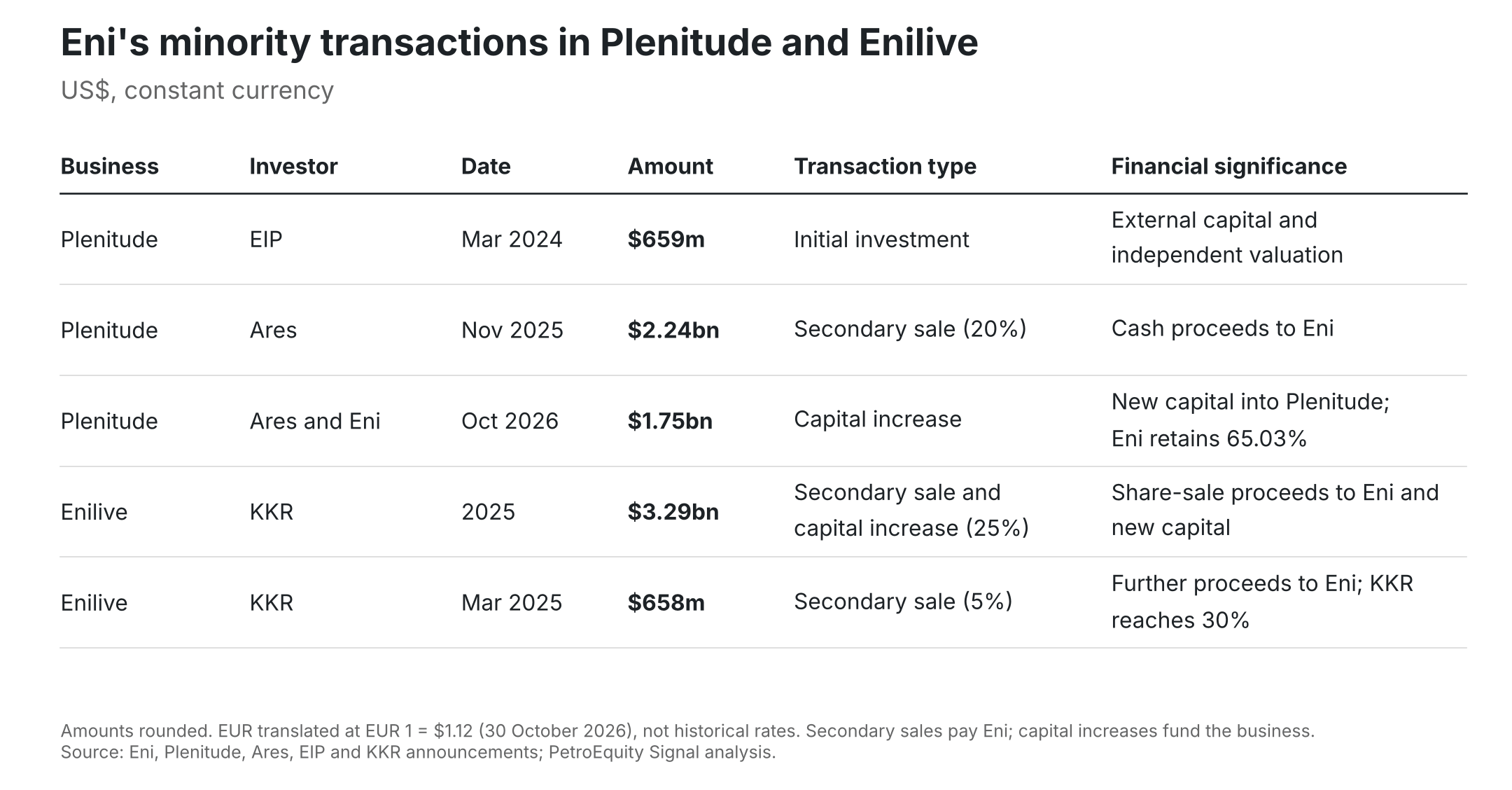
In 2025, Ares acquired a 20% interest in Plenitude for approximately $2.24 billion, generating proceeds for Eni. In October 2026, Ares contributed another $1.21 billion through a capital increase, while Eni contributed $538 million.
The new transaction valued Plenitude at approximately $12.0 billion before the capital increase, equivalent to an enterprise value of approximately $14.7 billion.
Following the reorganisation, Eni owned 65.03%, Ares 26.24% and Energy Infrastructure Partners 8.73%.
The transaction also established joint control between Eni and Ares, resulting in Plenitude being deconsolidated from Eni's financial statements.
Enilive has followed a similar route. KKR acquired an initial 25% interest through a transaction combining a purchase of shares held by Eni with new capital invested in Enilive, for a total of approximately $3.29 billion. It subsequently increased its ownership to 30%, providing Eni with approximately $658 million of further proceeds.
These are more than accounting valuations. Outside investors have committed substantial sums to acquire ownership interests in businesses that Eni created and developed.
The distinction between the two forms of investment matters to the financial outcome.
When an outside investor buys existing shares from Eni, the parent company receives cash. It has monetised part of its investment and can redeploy the proceeds, reduce debt or return capital to shareholders.
When an investor subscribes for new shares in Plenitude or Enilive, the money goes into the business. Eni's ownership is diluted, but the subsidiary receives funding that would otherwise have to come from existing shareholders or lenders.
Both transactions can be commercially attractive. They have different consequences for Eni's cash flow and retained economic interest.
The valuations are also useful evidence, although they do not establish the cumulative profitability of Eni's investments. Plenitude's $14.7 billion enterprise value is not a gain realised by Eni, and it cannot be compared directly with the company's historical expenditure without accounting for the capital invested over time.
Nevertheless, Eni has demonstrated that external investors are willing to finance these businesses at substantial valuations. That is an important commercial achievement.
The balance sheets tell another part of the story
The October 2026 Plenitude transaction also had a material effect on Eni's reported financial position.
By moving to joint control, Eni deconsolidated Plenitude's assets and liabilities, including approximately $2.6 billion of net debt. Eni's third-quarter results reported pro forma gearing of approximately 9%, alongside an increase in the planned share buyback to approximately $4.26 billion and an extraordinary dividend equivalent to $0.52 per share.
It would be wrong to attribute those shareholder distributions solely to the Plenitude transaction. Eni's upstream business continued to generate substantial cash, supported by production growth and strong operating performance.
Nor does deconsolidation eliminate Eni's exposure to Plenitude. It still owns approximately 65% of the business and will benefit or suffer as the value of that investment changes.
But the transaction illustrates how Eni has used corporate finance to manage the capital requirements of diversification. It has brought outside shareholders into the businesses, reduced its direct funding burden and established market valuations while preserving substantial ownership.
Equinor has also used project partners, farm-downs and external financing. Its 2020 sale to BP demonstrated that it understood the value of doing so.
The difference is that its Ørsted investment committed additional parent-company capital to an external renewable business, without control and with considerable exposure to the same industry risks already affecting its own projects.
Eni was attracting outside capital into businesses it controlled or jointly controlled. Equinor was allocating its own capital into a business controlled by others.
That is not a universal argument for selling minority stakes rather than buying them. It is a reason to examine the prices paid, the rights acquired and the risks retained.
Equinor has already reconsidered its strategy
Equinor's management has not ignored the deterioration in renewable project economics.
In February 2025, the company reduced its renewable capacity ambition for 2030 to 10–12GW and limited planned investment in renewables and low-carbon solutions through 2027. In April 2026, it sold half its shareholding in Scatec, another listed renewable energy company, and agreed to dispose of the remainder.
These decisions suggest a more disciplined approach to capital allocation than the earlier growth ambitions implied. The Ørsted holding remains, however, and Equinor's shareholders are still exposed to its market value.
The decision to retain the investment should now be based on Ørsted's future prospects and the returns available from alternative uses of the capital. The original acquisition price is relevant to judging management's investment record, but it is not a reason to hold the shares indefinitely.
Eni faces its own test. It has established attractive market valuations for Plenitude and Enilive and released substantial capital through minority transactions. The next question is whether the remaining interests generate durable earnings, distributions and returns sufficient to justify the capital Eni has retained.
That cannot yet be answered simply by looking at the valuations achieved in minority transactions. But there is already enough evidence to compare the financial decisions.
Equinor's sale to BP in 2020 captured value before offshore wind economics deteriorated. Eni's subsequent transactions brought external investors into its transition businesses and released capital for the parent company. Equinor's acquisition of Ørsted shares, by contrast, exposed its shareholders to a costly recapitalisation and a substantial unrealised decline.
Equinor understood the advantages of selling minority interests in offshore wind before Eni demonstrated them so effectively in its transition businesses. Its subsequent investment in Ørsted makes the contrast all the more revealing.
Exchange-rate assumption: All financial amounts are presented in US dollars. Historical DKK and EUR transactions are translated at indicative 30 October 2026 rates of DKK 1 = $0.1493 and EUR 1 = $1.1200, rounded. These constant-currency translations are for comparability and do not represent the actual USD cash amounts at historical transaction dates. Original reporting-currency figures and transaction dates are retained in the supporting workbook.
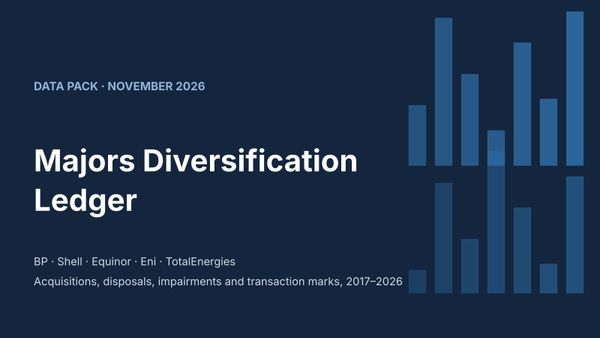
Data: The transaction records, impairments, valuation comparisons, sources and open verification items behind this article are in the Majors Diversification Ledger, a free Excel workbook covering BP, Shell, Equinor, Eni and TotalEnergies.
Sources: Equinor announcements on its Ørsted stake (October and December 2024) and rights-issue participation (September 2025); Ørsted rights issue result (October 2025); Equinor quarterly results 2025–2026 and February 2025 capital markets update; Equinor 2020 announcement of the Empire Wind and Beacon Wind sale to BP; Eni press releases on Plenitude (EIP, Ares and the October 2026 reorganisation) and on KKR's investment in Enilive; Eni third-quarter 2026 results; reporting on Equinor's Scatec sale (April 2026) and Empire Wind 1 progress (October 2026).
Disclosure: This analysis is based on publicly reported company announcements and financial statements, supplemented by the PetroEquity Signal Majors Diversification Ledger. Unrealised market movements, impairments, cash proceeds and enterprise valuations are distinguished and are not aggregated into a single investment return. This article represents analysis and opinion, not investment advice.