Project Bronco: Should BPX be Set Free?
BP’s shares trail every major peer. Project Bronco, an illustrative PetroEquity Signal pitch book, asks whether separating BPX Energy, BP’s US shale business, could unlock its value, and what BP would look like without it.

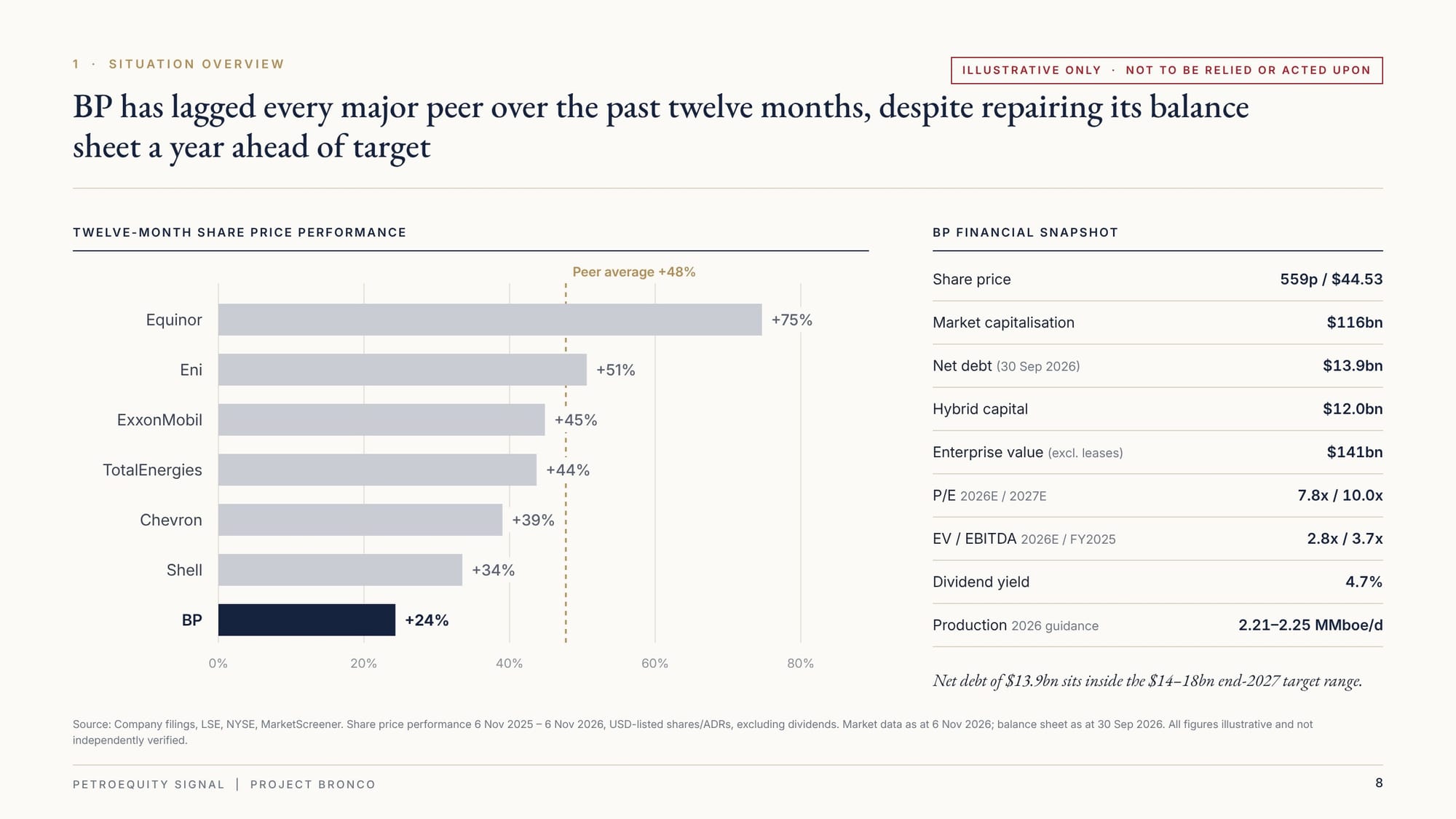
BP has spent much of the past two years trying to convince investors that its businesses are worth more than the market is prepared to pay for them. The company has changed its strategy, replaced senior leadership, reduced debt and begun disposing of assets. Its balance sheet is considerably stronger, yet BP continues to trade at a substantial discount to its American competitors, and its shares have underperformed every other major oil company over the past twelve months.
There is another way to approach the problem. Rather than continue trying to persuade investors to value BP differently, the company could separate a business that the market already knows how to value. That business is BPX Energy, BP's US onshore oil and gas operation, which is already a substantial American independent producer in everything but ownership.
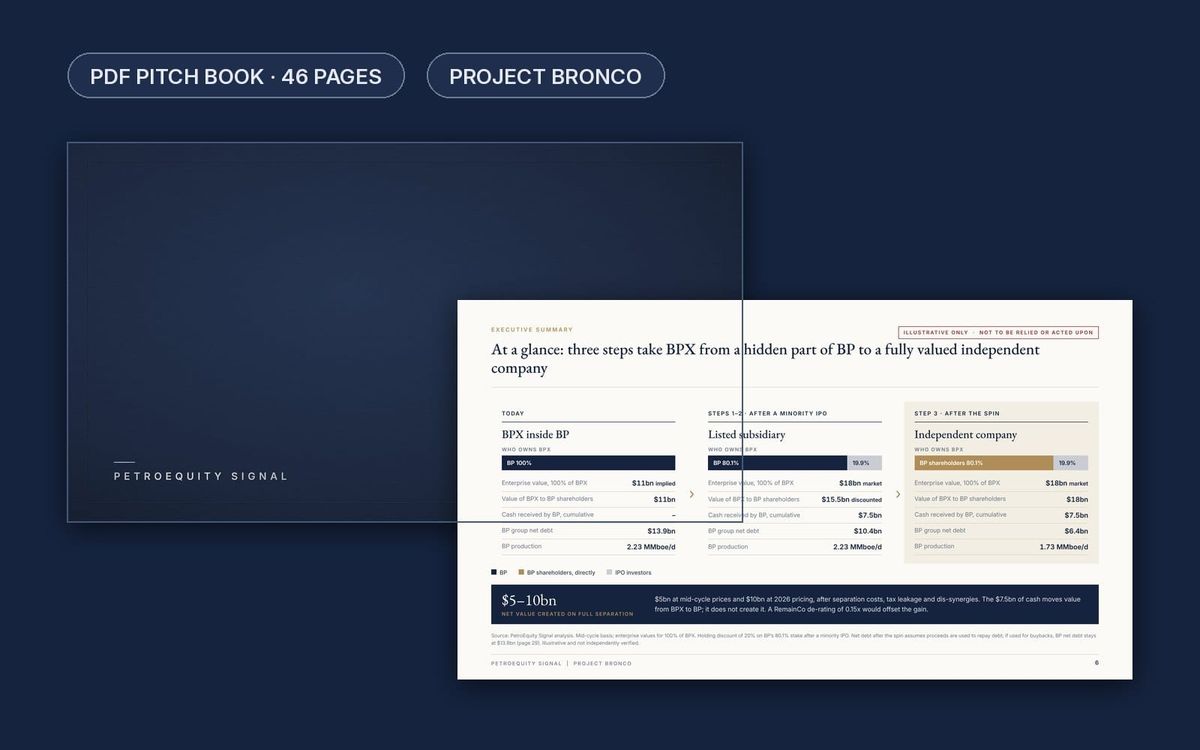
To explore the possibility, PetroEquity Signal has undertaken a paper exercise. The result is Project Bronco, an illustrative 46-page investment banking pitch book, structured as though presenting a strategic proposal to BP's board and senior management. Using publicly available information and simplified financial assumptions, it examines what BPX might be worth independently, how a transaction could be structured, what BP could receive, and what the remaining company might look like.
The exercise is hypothetical rather than actionable. But approaching the problem as an investment banker would, rather than simply advocating a break-up, imposes a useful discipline. It requires consideration of the financial, commercial and strategic consequences, including the possibility that separating BPX could destroy rather than create shareholder value.
A valuable business inside a discounted company
BPX produces approximately 500,000 barrels of oil equivalent a day from the Permian, Eagle Ford and Haynesville basins. It accounts for roughly a fifth of BP's production, with plans to exceed 650,000 barrels a day by 2030, and has an identified resource base exceeding seven billion barrels of oil equivalent. It is one of BP's principal sources of production growth and has sufficient scale to rank alongside several established US independent producers.
The American oil industry has spent the past decade consolidating. ExxonMobil acquired Pioneer Natural Resources, Diamondback bought Endeavor, ConocoPhillips acquired Marathon Oil, and Devon and Coterra combined their businesses. These transactions have created increasingly large, focused producers with substantial drilling inventories, lower operating costs and access to deep American capital markets.
Investors understand these companies. They can compare acreage quality, well performance, production costs, development budgets, leverage and shareholder distributions. The market has developed a reasonably consistent framework for valuing US independent producers, although multiples naturally vary with commodity prices, asset quality and growth prospects. BPX operates in this same industry but is valued as part of BP, a much larger and more complicated international integrated oil company.
At the beginning of November 2026, BP's enterprise value was approximately three times its trailing EBITDA, against a median of around five times for a selection of major US independent producers. The comparison is imperfect because BP owns refineries, trading operations, international upstream assets and other businesses with very different economics. Nevertheless, it raises the possibility that BPX might attract a substantially higher valuation as a standalone American producer.
Using indicative standalone EBITDA of $3 billion at mid-cycle commodity prices and $4 billion under stronger 2026 conditions, the exercise suggests an enterprise-value range of approximately $15–26 billion on US shale trading multiples. Applying BP's own group multiple produces an illustrative value of around $11 billion. A separate residual valuation, which assigns values to BP's other businesses, also suggests that relatively little of the group's current market value may be attributable to BPX.
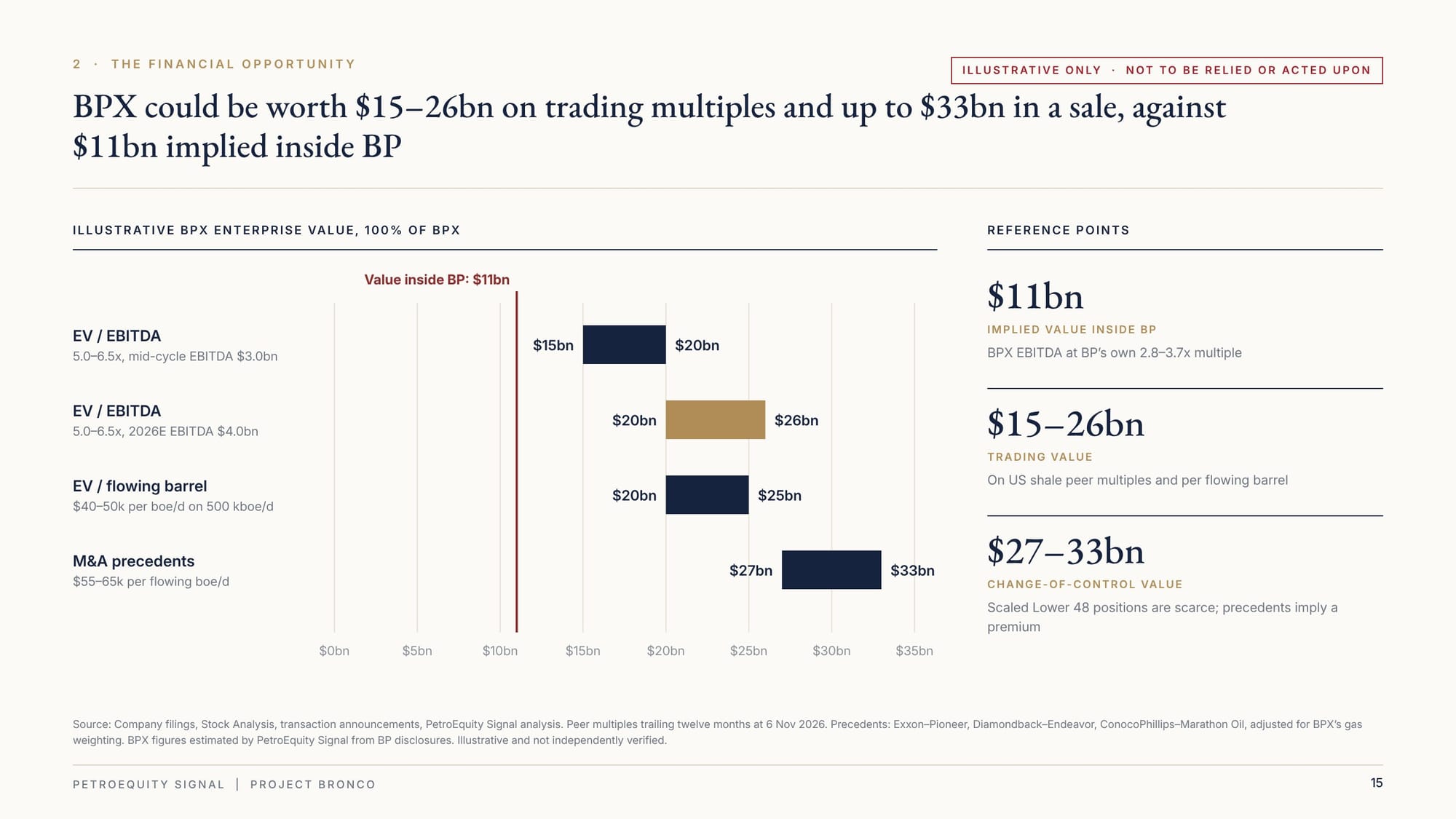
Neither calculation establishes that BPX is being mispriced. The group multiple reflects businesses and liabilities with very different characteristics, while the residual analysis is sensitive to assumptions about BP's other operations. But the potential valuation difference is substantial, and it raises a broader question about whether BPX could become more valuable through independence rather than simply attract a higher multiple.
What independence could change
Within BP, BPX competes for investment alongside deepwater projects in the Gulf of America, international gas developments, refining and the rest of the group's portfolio. These businesses have different development cycles, investment requirements and risk profiles, yet they compete for the same budget. An independent BPX could determine its own capital allocation, balancing drilling activity, production growth, acquisitions and shareholder distributions according to the economics of American shale.
There is also the question of consolidation. BPX is already larger than several listed US independent producers and, as a separately quoted company, would possess its own acquisition currency and a dedicated shareholder base. That could make it a consolidator rather than simply an acquisition target, with opportunities to acquire adjacent acreage, improve infrastructure utilisation and extend its drilling inventory.
The industry is increasingly concerned with sustaining production, improving well productivity and managing the declining inventory of its most attractive drilling locations. BPX would enter that market with material positions in three important basins, including substantial natural gas exposure in the Haynesville. The expansion of US LNG export capacity towards 2030 could also improve the commercial environment for Gulf Coast gas production, although stronger demand does not guarantee higher realised prices.
BP already owns these opportunities and could pursue them without separating BPX. The argument for independence must therefore go beyond the expectation of a higher trading multiple. It rests partly on whether a focused management team, its own capital structure and greater freedom to participate in consolidation could create opportunities that are harder to realise within BP.
The harder question is what remains of BP
The case for BPX independence is relatively easy to explain. The case for BP without BPX is more demanding, because separation would remove one of the group's principal sources of production growth. It would also change the composition of BP's earnings, investment requirements and future opportunities.
On the illustrative numbers, BPX accounts for approximately 22% of group production but only around 8% of mid-cycle EBITDA. Its annual development budget is estimated at $2.2 billion, representing roughly 16% of BP's group capital expenditure. Removing BPX would therefore reduce BP's reported production substantially, but have a much smaller effect on current earnings and investment requirements.
At assumed mid-cycle commodity prices, BP's EBITDA would decline from approximately $37.6 billion to $34.6 billion, while capital expenditure would fall from roughly $13.75 billion to $11.5 billion. This does not mean BPX is unattractive; it is growing, and growth requires investment. The comparison nevertheless suggests that BP could surrender considerable production growth without sacrificing an equivalent proportion of its present cash-generating capacity.
The remaining company would have a different character. Its upstream production would be concentrated in established international assets and long-cycle developments, with refining, marketing and trading continuing to contribute to earnings. A lower investment budget could support a clearer shareholder-distribution policy, potentially making BP more attractive to investors seeking cash returns rather than production growth.
But investors might instead view BP as a less attractive company without its American growth engine. This is arguably the most important risk in the transaction. The exercise suggests that a reduction of only 0.15 times EBITDA in the valuation multiple of the remaining BP could offset approximately $5 billion of value created through separating BPX.
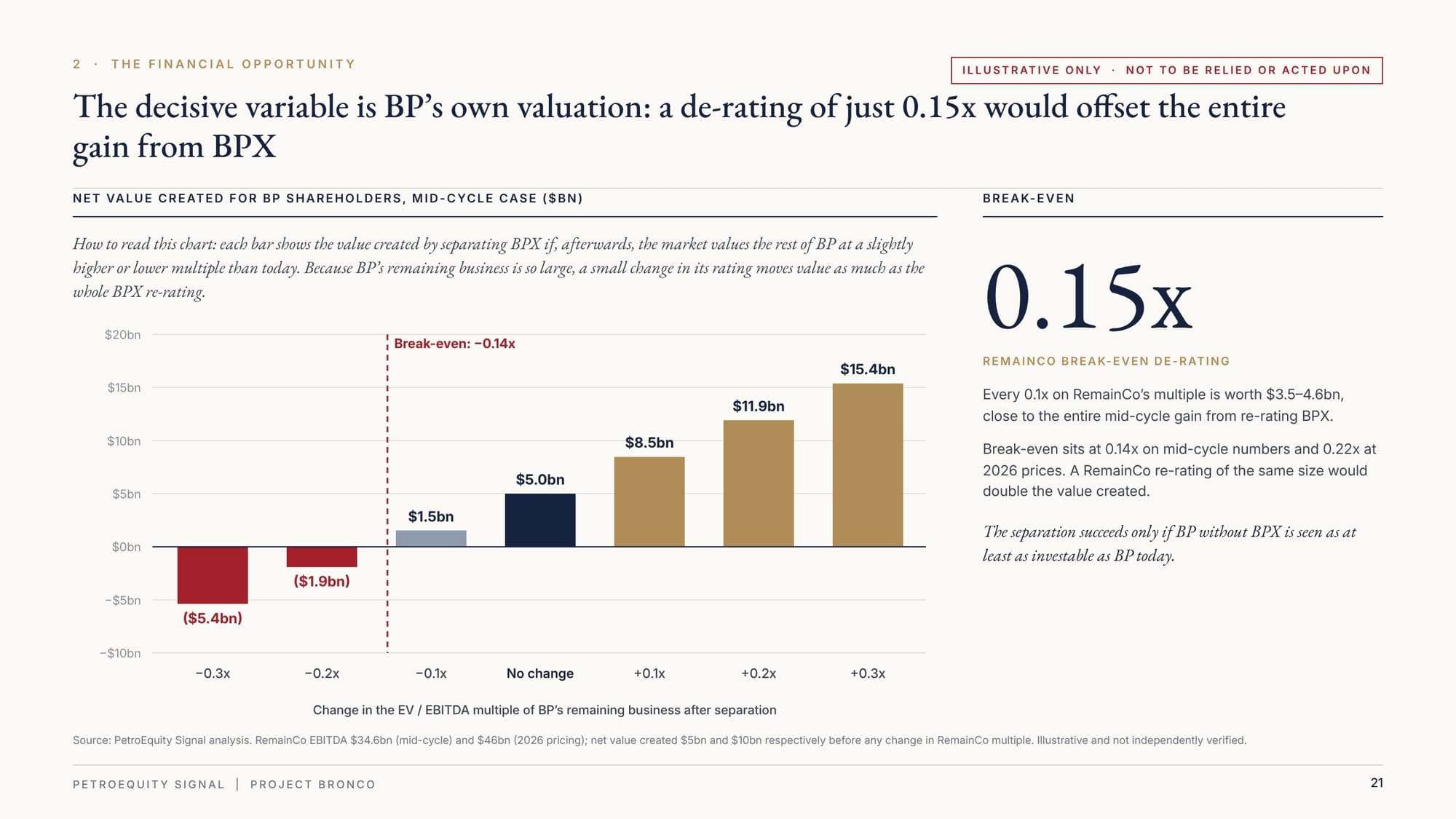
The transaction would therefore have to stand on two propositions: that BPX could command a higher valuation independently, and that BP without BPX would remain an attractive investment. Management would need a convincing capital allocation and shareholder-distribution strategy for the remaining company before committing to a separation.
There is more than one way to realise the value
One of the more interesting conclusions from the exercise is that BP need not decide immediately whether to surrender control of BPX. A minority flotation could establish an independent market valuation while preserving the option of a full separation later.
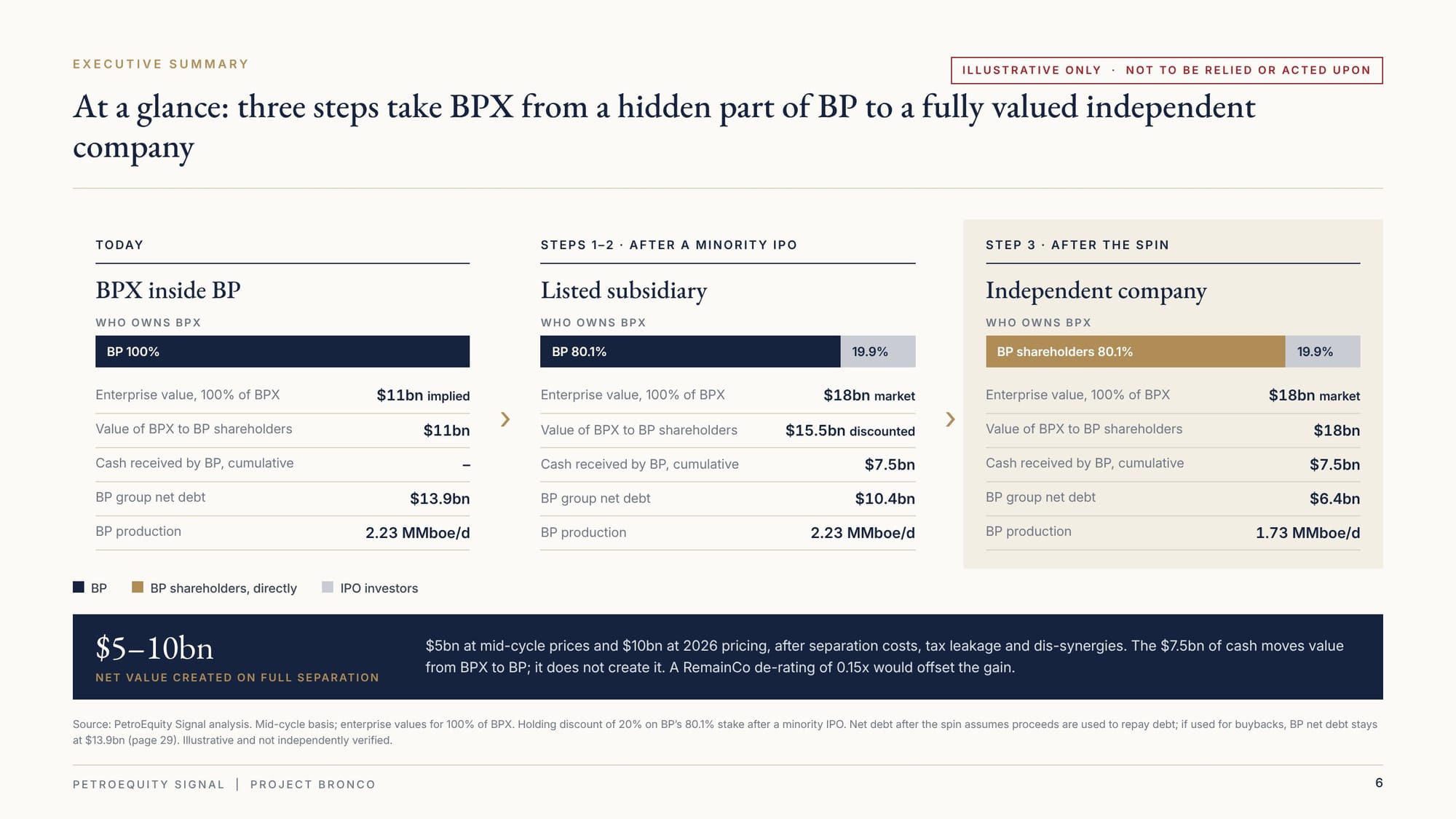
For example, BP could float 19.9% of BPX on the New York Stock Exchange while retaining 80.1%. BPX would acquire a public market valuation and outside shareholders, while BP would continue to control and consolidate the business. It would retain the majority of BPX's future growth and any appreciation in its value, while receiving proceeds from the minority sale.
A minority listing could be a destination in its own right rather than merely the first stage of a spin-off. BP might retain control for several years while BPX establishes its market identity and potentially participates in further US consolidation. Although the retained holding could continue to attract a holding-company discount, BP would avoid having to make an immediate decision about the future of its entire American business.
If BP subsequently chose a full spin-off, its remaining 80.1% holding would be distributed directly to BP shareholders, leaving BP itself with no ownership of BPX. A split-off would offer another route, allowing shareholders to exchange BP shares for BPX shares and potentially enabling BP to retire a substantial proportion of its own equity. An outright sale, a merger with another US producer or the introduction of strategic investors would offer different balances of cash, control and future participation.
There is also considerable flexibility over the financial structure. A standalone BPX could raise debt and distribute the proceeds to BP before a flotation or separation. The exercise considers debt levels between $2 billion and $6 billion, with approximately $3–4 billion appearing a plausible starting point against mid-cycle EBITDA of $3 billion.
The temptation would be to extract as much cash as possible. But higher borrowing would reduce BPX's equity value and resilience during a commodity downturn, potentially undermining its ability to sustain production and pursue acquisitions. California Resources' financial difficulties following its heavily leveraged separation from Occidental provide a useful warning about the consequences of leaving a spun company with too much debt.
An illustrative $4 billion debt-funded distribution combined with a secondary IPO of 19.9% could provide BP with approximately $7.5 billion of gross cash proceeds. This is not new shareholder value created: the borrowing-funded dividend transfers value from BPX to BP, while the IPO monetises an existing interest. The economic benefit would depend on the valuation achieved, the costs and taxes involved, and what BP ultimately did with the proceeds.
BP could reduce debt, repurchase its own shares, pay a special dividend or retain funds for investment. The company would also need to preserve valuable commercial relationships, particularly BP's trading and marketing arrangements with BPX. Separation of ownership need not mean severing commercial ties, although the allocation of transportation commitments, midstream interests, liabilities and guarantees would require careful negotiation.
An option worth examining
BP is in a better position to contemplate such a transaction than it was a year ago. By the third quarter of 2026, reported net debt had fallen to approximately $13.9 billion, already within the company's $14–18 billion target range for the end of 2027. Asset disposals have accelerated, the board and senior management have changed, and a further strategy update is scheduled for 15 December in New York.
The company is not being forced into a sale by an immediate balance-sheet crisis. It can examine alternatives from a position of greater financial strength and retain BPX if the terms are unattractive. A staged approach would allow management to establish standalone earnings and borrowing capacity, test investor demand, and examine the consequences for BP before committing to any structural change.
There are useful precedents. Ferrari was partially listed before being separated from Fiat Chrysler, while Eni established a separately quoted valuation for Vår Energi but retained majority ownership. Abbott separated AbbVie, and ConocoPhillips separated its downstream operations into Phillips 66. The circumstances differ, but they demonstrate that businesses with different financial characteristics and investor bases need not remain under common ownership indefinitely.
The illustrative calculations in Project Bronco suggest that a full separation of BPX could create approximately $5–10 billion of net shareholder value before any change in the valuation of the remaining BP. That is meaningful, but not overwhelming against BP's market capitalisation of approximately $116 billion, particularly given the uncertainties surrounding standalone earnings, tax treatment and market conditions.
The greater opportunity may lie in changing what both companies could become. BPX might develop into a substantial American independent producer with greater freedom to participate in consolidation, while BP could emerge as a more focused integrated company with lower investment requirements and greater capacity for shareholder distributions. Equally, investors might decide that BP is worth less without its growth engine, leaving shareholders little better off after a complicated transaction.
BP does not need to commit to a full separation to explore those possibilities. A minority flotation could establish a market valuation and introduce strategic flexibility while allowing BP to retain control. Whether the process stopped there, continued towards a spin-off or led to an entirely different transaction would depend on the value available to shareholders.
Project Bronco
The accompanying Project Bronco discussion book takes this proposition beyond the narrative and examines it in the format of an investment banking presentation to BP's board and management. Its 46 pages cover the valuation of BPX, the consequences for BP, alternative transaction structures, debt capacity, shareholder returns, commercial agreements and execution considerations. It also examines how the outcome changes with commodity prices and the market's valuation of the remaining BP.
The purpose of the exercise is not to advocate a particular transaction. It is to provide a structured way of examining a potentially valuable strategic option, including the competing alternatives and the circumstances in which separation might destroy rather than create value. The book is deliberately illustrative, using public information and simplified assumptions rather than the management data and detailed modelling required for an actionable proposal.
Project Bronco has not been commissioned by, reviewed by or presented to BP. It is an independent PetroEquity Signal paper exercise, intended to show how an investment banking discussion around such a transaction might be developed. Readers may agree with the premise, dispute the valuations or conclude that BP is better off retaining BPX; the supporting calculations and alternatives are provided so that they can examine the proposition for themselves.
Project Bronco is an independent, unsolicited and illustrative strategic proposal prepared by PetroEquity Signal using publicly available information. Its financial estimates have not been independently verified and should not be relied upon for investment decisions.
Disclosure: the author has no position in BP